
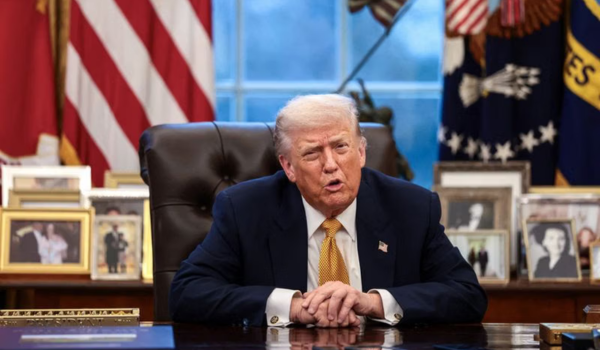
For India, President Donald Trump’s invitation to the much-discussed Gaza Peace Board presents a complex diplomatic challenge rather than a straightforward opportunity, potentially forcing New Delhi to navigate between a Trump-led platform and its established foreign policy positions.
US President Donald Trump has described his proposed Board of Peace as “the greatest and most prestigious ever,” with invitations now being rolled out. India is among the invitees, but membership in what Trump calls his own UNSC could pose diplomatic risks, forcing New Delhi to tread carefully.
While the Board of Peace is being presented by President Trump as a mechanism to supervise Gaza’s reconstruction after the war, analysts caution that its mandate may be far broader. They suggest the initiative could weaken the role of the UN Security Council and signal a US effort to establish a parallel global peace and security structure under its leadership.
India’s potential participation in the Board of Peace has drawn scrutiny, with experts noting that for a country committed to multilateralism, joining a US-led forum outside the UN framework could prove diplomatically challenging.
WHAT IS TRUMP’S BOARD OF PEACE?
Proposed in September 2025, the board was set up to oversee “Phase Two” of the US-brokered ceasefire in Gaza, following the conclusion of the 2023–2025 conflict.
The board’s immediate role is to supervise the National Committee for the Administration of Gaza (NCAG), a Palestinian technocratic body, while managing Gaza’s reconstruction and overseeing the disarmament of Hamas.
The Board of Peace is a US-led intergovernmental body, set up by Donald Trump, to handle global conflict resolution and rebuilding.
Chaired by Donald Trump, the board features prominent figures such as businessman and former US presidential adviser Jared Kushner, former British prime minister Tony Blair, and US Secretary of State Marco Rubio. Analysts view the panel as an effort to create a powerful alternative to established United Nations institutions.
WHY JOINING TRUMP’S PEACE BOARD COULD BE TRICKY FOR INDIA?
US President Donald Trump’s proposed Board of Peace has been positioned as an exclusive global forum, with invitations reportedly extended to nearly 60 world leaders.
Permanent membership, however, comes with a mandatory $1-billion contribution to a reconstruction fund controlled by the board—effectively turning peace-making into a pay-to-participate club.
Such a structure risks producing fragmented and selective outcomes. Unlike the UN General Assembly or the Security Council, not all stakeholders would have a seat at the table. Moreover, bestowing a “peace” mandate through such a narrowly constituted body could appear arbitrary and, at times, diplomatically uncomfortable.
INDIA FACES AMBIGUITY OVER THE MANDATE OF TRUMP’S PEACE BOARD
Compounding the unease is the lack of clarity around the Peace Board’s mandate. Although its immediate focus is Gaza, the board’s charter reportedly makes no explicit reference to the territory, according to The New York Times. Instead, the use of sweeping phrases such as “world peace” has sparked speculation that the body could broaden its remit to other conflicts and potentially serve as a US-dominated alternative to the UN Security Council.
Further complicating matters is the Palestine question, an area where India has long pursued a carefully balanced diplomatic approach. New Delhi has consistently supported a two-state solution and Palestinian rights, even as it has expanded strategic and defence cooperation with Israel. Any participation in a West-centric, Trump-driven body focused on Gaza would inevitably be viewed through this lens, requiring India to weigh not only policy choices but also global and Global South perceptions.
The challenge is heightened by President Trump’s past remarks suggesting that the US could take over and “develop” the Gaza Strip into the “Riviera of the Middle East.” How India distances itself from such rhetoric—while remaining engaged—will be closely watched. Achieving this would demand careful diplomacy, particularly given New Delhi’s need to avoid friction with an administration known for deploying punitive tariffs with little warning. Navigating membership in such a grouping without being drawn into Trump’s populist and often off-the-cuff positions would be a delicate and noteworthy exercise.