
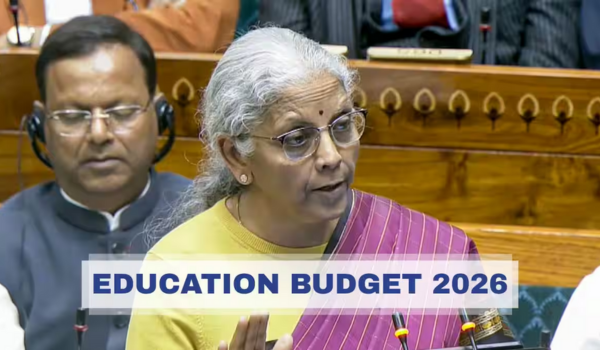
The Union Budget 2026 has brought a clear shift in education spending priorities, with the government increasing support for school-level schemes while trimming allocations for minority scholarships in higher education. The move signals a stronger focus on strengthening foundations in early and school education, even as concerns grow over reduced financial support for students pursuing college and university studies.
Under the new budget, school education has emerged as a major beneficiary. Several schemes aimed at improving classroom infrastructure, teacher training, digital learning tools, and student support have received a funding boost. The government’s message is clear: building strong basics in literacy, numeracy, and overall learning outcomes at the school level is being seen as the most effective way to improve the quality of education in the long run.
Officials and education planners believe that investing more in schools will help reduce dropout rates, improve learning levels, and prepare students better for higher education and the job market. More resources are expected to flow into areas such as smart classrooms, updated textbooks, teacher capacity building, and support for students from economically weaker backgrounds. There is also a renewed push for early childhood and foundational learning, which is increasingly being viewed as the backbone of the entire education system.
At the same time, the budget has scaled back funding for minority scholarships in higher education. These scholarships have traditionally helped students from minority communities afford college and professional courses. The reduction has raised concerns among students, parents, and education advocates, who worry that higher education may become less accessible for those who rely on financial assistance to continue their studies.
Supporters of the budget changes argue that strengthening school education will, over time, create a more level playing field for all students, including those from minority and disadvantaged backgrounds. The idea is that better schooling will reduce the need for remedial support later and improve overall participation and performance in higher education. However, critics point out that the immediate impact of cutting scholarships could be felt by thousands of students who are currently enrolled or planning to enroll in colleges and universities.
For many families, scholarships are not just financial aid they are the difference between continuing education and dropping out. With costs of higher education rising, even a small reduction in support can place extra pressure on households already struggling to manage expenses. Education experts warn that this could affect enrollment rates in professional and technical courses, where fees are often higher.
The government, meanwhile, has emphasized that Budget 2026 is about making strategic choices and using resources where they can have the widest and longest-lasting impact. By focusing more on school education, policymakers aim to improve learning outcomes at scale and ensure that future generations are better prepared from the start of their academic journey.
In the coming months, the real impact of these changes will become clearer as states, schools, and institutions begin implementing the new budget allocations. While the boost to school education is being widely welcomed, the reduction in minority higher education scholarships is likely to remain a topic of debate, especially among student groups and education stakeholders.
Overall, Budget 2026 reflects a significant rebalancing of education priorities one that strengthens the base of the system but also raises important questions about access, equity, and support for students at the higher education level.
For more details and the fastest updates, follow us on @namma.updates. Stay informed and stay connected.