
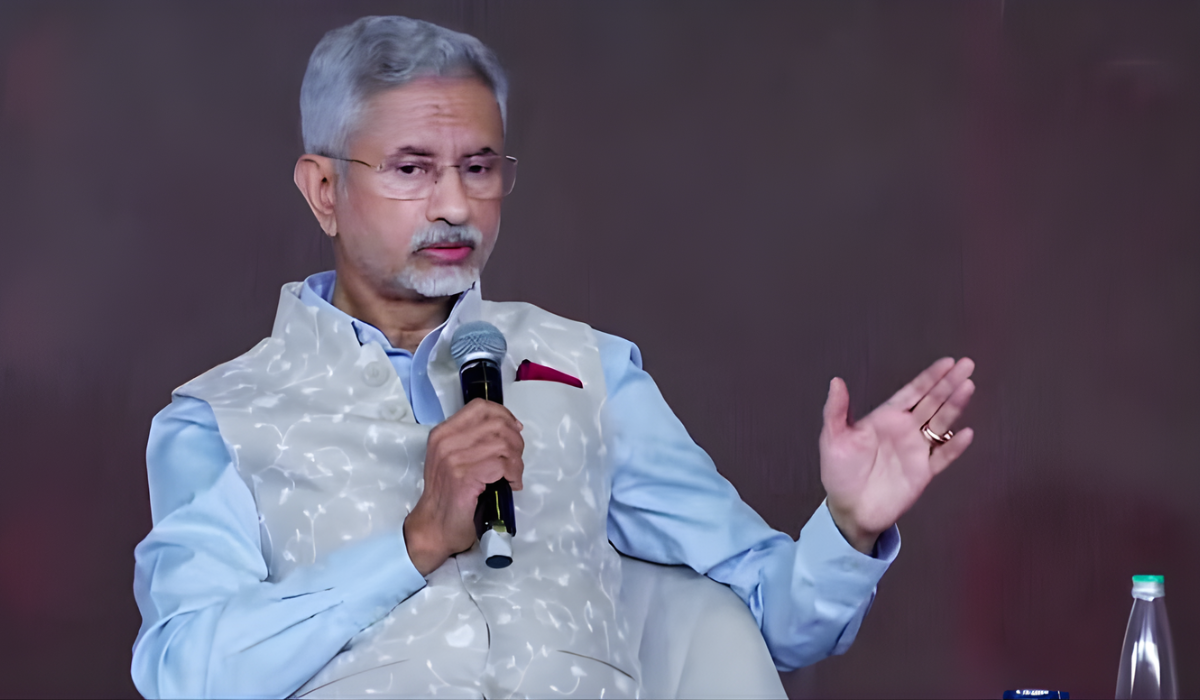
This is the first time the External Affairs Minister has addressed the issue that brought the Middle East conflict close to India’s doorstep. Jaishankar said India allowed the Iranian ship, IRIS Lavan, to dock in Kochi on humanitarian grounds.
External Affairs Minister S. Jaishankar said on Saturday that India allowed an Iranian naval ship to dock at Kochi on humanitarian grounds, rather than due to geopolitical considerations, despite Iran’s ongoing conflict with the United States and Israel. Speaking at the Raisina Dialogue, he also described the sinking of another Iranian vessel, IRIS Dena, by a US submarine in the Indian Ocean as “unfortunate,” while outlining India’s official account of how the conflict reached close to its shores.
The IRIS Lavan docked only days before the IRIS Dena was sunk by a US torpedo on March 4, an attack that killed more than 80 Iranian sailors. About 32 crew members were later rescued by the Sri Lankan navy.
Iranian Ship Arrives at Kochi Port
Jaishankar said that on the day the US and Israel launched their offensive against Iran, India received a request from Tehran to allow one of its naval ships operating in the region to dock at an Indian port. The vessel, carrying 183 crew members—mostly young cadets—had developed a technical problem.
He explained that the Iranian ship had originally been deployed for a naval drill but ended up “on the wrong side of events” as tensions in the region rapidly escalated.
The vessel had been in the area to participate in the International Fleet Review 2026, a maritime exercise hosted by India in mid-February.
“We received a message from Iran stating that one of its ships, likely the closest to India at that time, wanted permission to enter an Indian port as it was experiencing technical difficulties,” Jaishankar said.
The Union Minister added that India approved Iran’s request on March 1, and the IRIS Lavan eventually docked in Kochi on March 4.
“On March 1, we granted permission for the ship to enter our port. It took a few days for the vessel to sail in before it docked in Kochi. Many of those on board were young cadets. When the ship first set out and when it finally arrived here, the situation in the region had changed dramatically,” he explained.
Jaishankar emphasised that India’s decision was primarily based on humanitarian considerations.
“We approached the situation from a humanitarian perspective, beyond any legal or geopolitical concerns, and I believe we made the right decision,” he said.
So far, India has not taken sides in the conflict, consistently calling for de-escalation, restraint, and dialogue. On Thursday, Foreign Secretary Vikram Misri visited the Iranian Embassy in New Delhi to offer condolences following the death of Supreme Leader Ayatollah Ali Khamenei.
On the Sinking of IRIS Dena
The External Affairs Minister also briefly referred to the sinking of the IRIS Dena, an incident that drew criticism from the Congress over the government’s alleged “silence”.
“One of the incidents occurred in Sri Lanka, where the authorities there took the decision they considered appropriate, and unfortunately one of the ships did not make it,” he said, indicating that the event happened within Colombo’s jurisdiction.
Amid criticism from the opposition, the government stated that it had launched search and rescue operations after IRIS Dena issued a distress call. A maritime patrol aircraft, along with INS Tarangini, was deployed for the mission, while the Navy also sent INS Ikshak to assist in the rescue efforts.
Jaishankar also spoke about the geopolitical realities of the Indian Ocean region, addressing ongoing debates on social media.
“Please understand the realities of the Indian Ocean. Diego Garcia has been present in the region for the past five decades. Similarly, foreign military forces have been stationed in Djibouti since the early years of this century,” he said.