
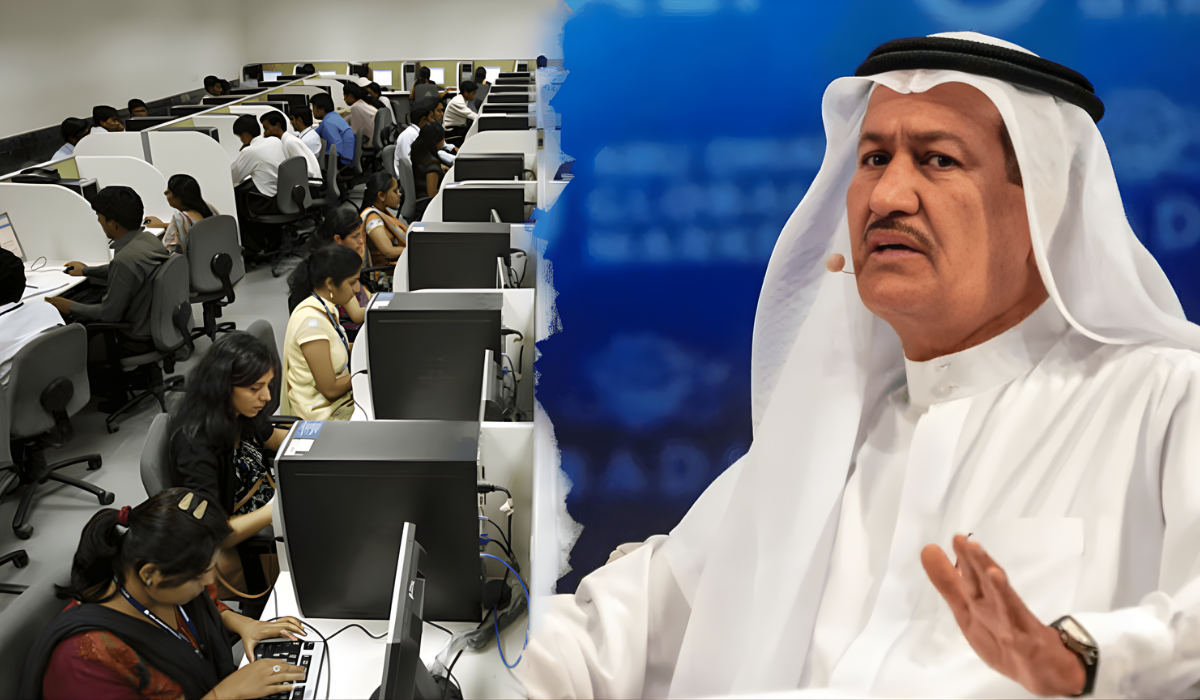
At the World Economic Forum (WEF) 2026 in Davos, Dubai-based business tycoon Hussain Sajwani issued a strong warning about the future of global employment. He said artificial intelligence is not merely a productivity tool but a transformative force for the job market, adding that economies that rely heavily on outsourced work could be particularly at risk. His remarks have triggered widespread discussion about how AI could reshape international labour markets, especially in India’s large outsourcing industry.
Sajwani, the Founder and Chairman of Damac Group, said AI has the potential to transform the world “10 or even 100 times more” than the internet did. He warned that countries failing to adopt the technology could risk being left behind, predicting that nations dependent on outsourced labour may face major disruption as automation continues to expand.
Why India’s Outsourcing Industry Faces Potential Risks
India has long been recognised as a global outsourcing hub, with millions employed in IT services, business process outsourcing (BPO), call centres, and back-office operations, all of which play a major role in driving the country’s economy. However, a 2025 industry report indicates that AI-driven automation could significantly transform this sector. The decision by Tata Consultancy Services (TCS) to cut 12,200 jobs has been viewed by analysts as an early sign of a wider trend, with estimates suggesting that up to 500,000 roles could be affected in the coming years if automation continues to replace routine tasks.
Many of these positions – including routine coding, manual testing, customer service, and administrative work – are particularly vulnerable because AI systems can complete them faster and at a lower cost. Reflecting these concerns at the World Economic Forum in Davos, Hussain Sajwani said that in the future AI could replace up to 80% of jobs in fields such as accounting, nursing, and other routine professions, which could also reduce demand for outsourced services.
While some BJP-aligned commentators on social media argue that such technological shifts are unavoidable and that India should focus on innovation and new AI-driven opportunities, many workers remain concerned about the potential impact on jobs and livelihoods that depend on the outsourcing industry.
Global AI Advancements vs Traditional Employment
Sajwani pointed to a growing global gap in AI adoption, stating that countries such as China, the United States, the UAE, and Saudi Arabia are rapidly expanding their AI capabilities through large-scale investments. Meanwhile, regions that delay adoption or impose excessive regulations risk falling behind in global competition. He also drew a historical comparison, noting that resistance to new technology can lead to setbacks, similar to the Ottoman Empire’s refusal to adopt the typewriter.
This concern is not merely theoretical. A recent LinkedIn poll found that the UAE ranks second globally in the use of AI tools among professionals, with a large share of employees already integrating generative AI into their daily work. This highlights how some labour markets are quickly adapting to the growing influence of AI.
At the same time, broader surveys indicate that many recruiters in the Gulf region expect generative AI to significantly affect employment. Several companies believe that existing roles will either evolve substantially or be replaced altogether as AI adoption expands.
Not Just Job Loss: AI Reshaping Jobs and Skills
However, experts emphasise that the impact of AI will not be limited to layoffs. The Indian Economic Survey 2026 notes that although automation may replace certain routine roles, it will also create new opportunities. It highlights the continued importance of human skills such as creativity, adaptability, and interpersonal abilities, which AI is less capable of replicating.
Analysts argue that India’s large talent pool and growing AI skill base could allow the country to transition from being mainly a provider of outsourced labour to becoming a centre for innovation and AI-driven services. Expanding training in AI and digital technologies, along with investments in data centres and computing infrastructure, could help protect the job market from disruption while generating higher-value employment.
Similarly, technology experts worldwide point out that in many markets – including the UAE – AI is not only replacing some jobs but also creating new roles in fields such as AI development, data science, robotics, and AI integration, even as it transforms existing professions.