
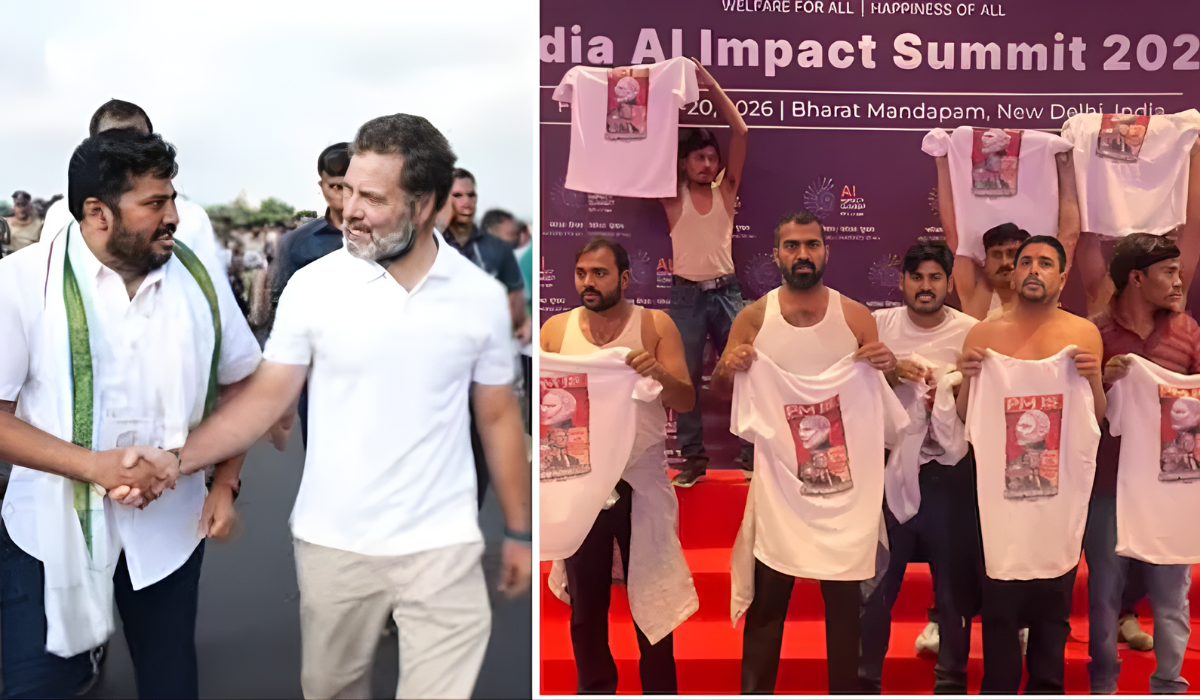
While speaking at a party event, Rahul Gandhi praised the Youth Congress members who staged a shirtless protest during the AI Summit, describing them as “lion-hearted.” The remark prompted a quick and sharp response from Amit Malviya of the Bharatiya Janata Party, who invoked an incident involving Jawaharlal Nehru to criticize the Congress leadership.
Rahul Gandhi voiced support for the Indian Youth Congress workers who staged a shirtless protest during the AI Summit, describing them as “babbar sher” (lion-hearted). The Bharatiya Janata Party, however, claimed the remark suggested Gandhi’s involvement behind the controversial episode.
Speaking to Congress workers in Delhi, Gandhi referred to the February 20 incident while criticizing the government over artificial intelligence policies. “Recently, we had an AI Summit. Kar diya kaam Youth Congress walon ne (the Youth Congress workers have done the job),” he said.
Taking aim at Narendra Modi, the leader of the opposition added that AI relies heavily on data. “Modi keeps talking about AI, AI, AI. But he has handed over all the data to the US and deceived the nation,” Gandhi alleged.
What Happened at the AI Summit?
On February 20, a group of shirtless members of the Indian Youth Congress entered a hall during the AI Summit, a global event attended by foreign leaders and leading technology CEOs, at Bharat Mandapam in the heart of Delhi.
The protest was staged against the proposed India-US trade deal, which the Indian National Congress claimed would undermine the interests of farmers. Following the incident, authorities arrested around 14 Youth Congress leaders, including its president Uday Bhanu Chib.
The BJP stated that Gandhi’s remarks indicated the protest was a “carefully planned experiment” allegedly organized at the Congress MP’s residence with the aim of embarrassing India on the global stage.
BJP Cites Nehru-Era Incident in Response
BJP IT Cell chief Amit Malviya referred to a historical incident to counter the claim, noting that even former Prime Minister Jawaharlal Nehru had once expressed a very different perspective on issues of “national character” and “loyalty.” Malviya pointed to an episode from the 1950s involving the succession dispute in the Indore royal family following the death of Maharaja Yeshwantrao Holkar II.
The BJP leader said that after the king’s death, a debate emerged over whether his American-born son, Richard Holkar, could inherit the legacy of the Holkar dynasty. The issue was taken up by the government of that time for deliberation.
“After discussions, Nehru took a firm stand that the heir to the throne should be the child born to an Indian mother,” Malviya wrote on X. Ultimately, Usha Devi Raje Sahib Holkar, the Maharaja’s daughter from his Indian wife, was officially recognised by the government as the successor to the Holkar legacy.
Malviya added that the episode set a clear precedent, arguing that national identity and loyalty were not abstract concepts but were closely tied to one’s origins and sense of belonging.
Referring to the incident while criticising Gandhi, Malviya suggested that the Leader of the Opposition was overlooking what he described as Nehru’s emphasis on national identity.