
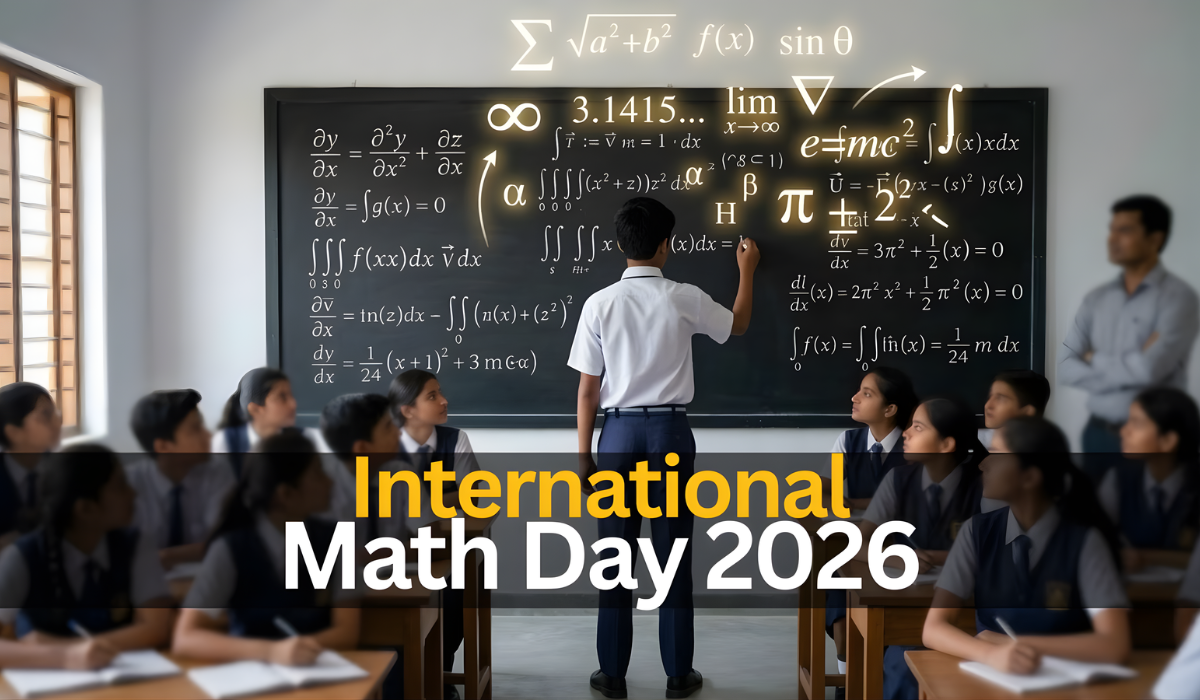
The International Day of Mathematics (IDM) is celebrated every year on March 14. Observed since 2020, the day highlights the importance of mathematics in everyday life. Schools often mark the occasion with special classroom activities, while global events are organized by UNESCO and the International Mathematical Union.
Significance
The International Day of Mathematics aims to raise awareness about the vital role mathematics plays in science, technology, and daily life. It also encourages students to engage with the subject through creative, interactive, and practical learning activities.
International Mathematics Day 2026 Theme
The theme for 2026 is “Mathematics and Hope.” It highlights the idea that mathematics, like hope, is a universal resource shared by people across cultures and societies.
Ancient Greek philosopher Thales of Miletus once said, “Hope is the most universal of all human possessions.” More than 2,500 years later, the International Mathematical Union suggests that the same idea can also be applied to mathematics.
On March 13, 2026, UNESCO, in collaboration with the International Mathematical Union and IMAGINARY, marked the occasion with a global webinar titled “Mathematics and Hope.”
Themes Over the Years
The first theme in 2020 focused on how mathematics appears across science and technology, nature, human activities, and even art and games. As part of the celebrations, students created short videos demonstrating how “Mathematics is Everywhere.”
In 2021, students used mathematics to design posters presenting ideas on how the world could become a better place. The 2022 celebrations encouraged participants to explore their surroundings and capture photographs highlighting mathematics in everyday life.
In 2023, students expressed their creativity by producing comics inspired by mathematics. The 2024 theme invited participants to incorporate mathematics into everyday objects and spaces to create “Math Remixes,” while the 2025 challenge focused on creating “Math You Can Touch.”
Each year, countries around the world are encouraged to take part through activities for students and the public in schools, museums, libraries, and other community spaces.
Classroom Activities
The International Mathematical Union has suggested several classroom games and activities that teachers can use to celebrate the International Day of Mathematics.
Some of these activities focus on mathematical ideas such as inheritance division and fair distribution. One example is Group Screening, an activity that shows how mathematics can make testing processes more efficient.
In this activity, samples from several individuals are tested together as a single group. If the combined test result is negative, all members of the group are considered negative. However, if the result is positive, further rounds of testing are carried out using smaller groups to identify the infected individuals.
This method, known as pooled testing, dates back to World War II, when the United States Army used it to screen recruits for Syphilis.
In classroom simulations, students are divided into teams and asked to identify infected individuals within a group through multiple rounds of testing. Afterwards, teams compare their strategies to determine which approach required the fewest tests.
History
The declaration of March 14 as the International Day of Mathematics was adopted by the Executive Council of UNESCO during its 205th session and was later approved at the organization’s 40th General Conference in November 2019.