
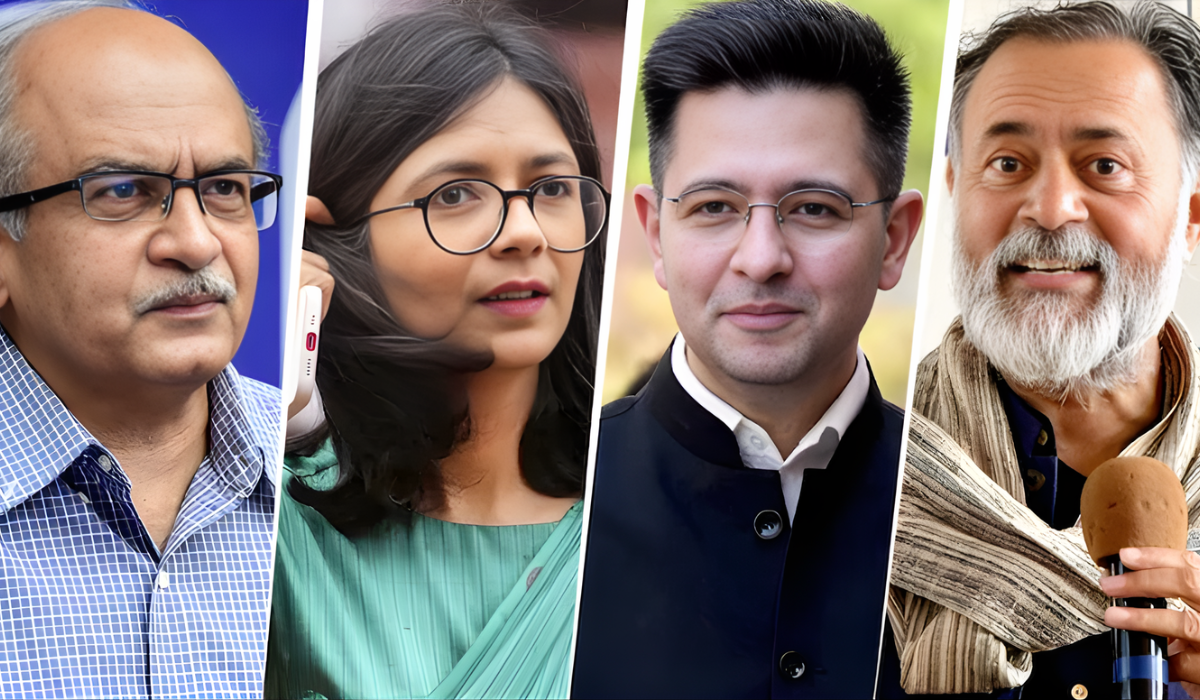
Arvind Kejriwal built the Aam Aadmi Party on a promise of principles, but it now appears to run on unquestioning loyalty. As leaders like Raghav Chadha drift away, it reveals a party driven by talent too ambitious to remain in the shadow of a single leader.
The betrayals that cut deepest in politics are often the ones you never anticipate. When an ideological rival turns hostile or an ambitious competitor makes a move, there’s at least some sense of familiarity – you understand the rules, you know the game.
But there is a quieter, more unsettling kind of loss reserved for the loyalist who slowly drifts away. Not the one who betrays you outright, but the one who simply fades – who starts making different choices, so subtly that you barely notice. Until one day, you realise that the person you trusted most – the one you backed, celebrated, and saw as an extension of your own rise – is no longer by your side, but standing somewhere else entirely.
That is the story of Raghav Chadha. That is the story of Arvind Kejriwal. That is also the story of Yogendra Yadav and Prashant Bhushan – in many ways, it is the story of the Aam Aadmi Party itself.
And in many ways, it stands as the most human chapter in Arvind Kejriwal’s long political journey.
The Prodigal Loyalist
Raghav Chadha’s journey in the Aam Aadmi Party began almost at the party’s inception. Backed by Arvind Kejriwal, he contributed to drafting the Delhi Lokpal Bill in 2012. From there, his rise was rapid. He emerged as the party’s television face, its youngest national spokesperson, and one of its most articulate debaters at a time when AAP needed both credibility and visibility. By 2015, following the party’s sweeping win in Delhi, Chadha – just 26 – was appointed national treasurer, a clear sign of the leadership’s trust and his firm place in the party’s inner circle.
The closeness of this bond was evident to anyone watching closely. Raghav Chadha’s engagement to actor Parineeti Chopra was held at Kapurthala House – the official Delhi residence of Punjab’s Chief Minister – with Arvind Kejriwal himself raising a toast. The only other time the residence was opened for a private ceremony was for Kejriwal’s own daughter’s wedding.
These were not mere gestures of a party leader rewarding a loyal functionary. It was a public signal of personal trust – an assertion of closeness. Which is precisely why what followed stood out so sharply.
The Silent Breakup
When Kejriwal was in jail, the Aam Aadmi Party needed its strongest voices. Yet, at that crucial moment, Chadha appeared to distance himself. Citing an eye condition, he travelled to London with Parineeti Chopra. Within the party, it quickly became a subject of discussion – the optics were unfavourable, giving the impression that when it mattered most, he chose himself.
The silence only deepened afterward. Even upon his return, Chadha seemed detached from the party’s agenda. He did not issue a statement welcoming a Delhi court’s decision to discharge Kejriwal in the excise case.
That absence spoke volumes – and both sides understood the message.
Senior leader Saurabh Bharadwaj later accused Chadha of engaging in “soft PR”: carefully curated, polished interventions on low-risk issues designed for visibility rather than confrontation.
Former Chief Minister Atishi Marlena put it more bluntly: “When Arvind Kejriwal was arrested, we were beaten and dragged on the streets. You may be afraid of going to jail and chose to leave for London, but we are Kejriwal’s soldiers and we will not back down.”
All The Kejriwal Men (And Women)
“Soldiers” – the word captures the core expectation at the heart of Kejriwal’s politics. It demands that his crisis becomes yours, that his enemies become yours, and that your individual political identity is fully subsumed into his narrative – leaving only one acceptable answer to the question, “What do you stand for?”
This, in many ways, reflects the deeper issue with Kejriwal’s style of leadership and, by extension, the Aam Aadmi Party.
Kejriwal gave Raghav Chadha a platform, a career, national visibility, and a seat at the table. Chadha, in turn, used those opportunities to grow into a figure who no longer fits neatly within Kejriwal’s fold. That is where the equation began to unravel. And this pattern has repeated itself, gradually, with others – Yogendra Yadav, Prashant Bhushan, Navjot Singh Sidhu, Swati Maliwal – the list is long.
To be fair, the story is not one-sided. Kejriwal did not lose his colleagues solely due to centralisation or mistrust. At various points, his associates also faltered – driven by ambition, ego, or hesitation at critical moments. The larger tragedy of AAP lies in this: a group of capable individuals, united briefly by a common purpose, ultimately pulling in different directions and drifting apart.
To understand this, one must return to the most turbulent chapter – not Raghav Chadha’s quiet drift, but what many see as the original rupture.
Founding Fathers & The “Murder Of Democracy”
In March 2015, just a month after the Aam Aadmi Party secured 67 of 70 seats in Delhi, a national council meeting on the city’s outskirts spiralled into chaos. Yogendra Yadav and Prashant Bhushan were removed from the party’s national executive. Both described the episode as the “murder of internal democracy,” alleging that dissent was crushed through intimidation.
Bhushan later told reporters, “All dreams of a movement have been shattered by a small coterie and a dictator.”
Yadav, widely regarded as one of the finest psephologists of his generation, expressed his anguish, asking: “How would you feel if someone drags you and throws you out of your own house?”
Veteran activist Medha Patkar, who had lent the movement significant moral weight, resigned from the party the same day. She said the party had turned into a “tamasha,” with its core political principles being undermined.
From the outside, it appeared as though Arvind Kejriwal was turning on his own co-founders – and in many ways, that perception wasn’t far from reality. Moving first, he offered to step down as convener, a proposal quickly rejected by the gathering, effectively reducing the choice to a stark binary: him or them.
The roots of the conflict also lay in an internal power struggle, particularly between Manish Sisodia and Yogendra Yadav over candidate selection in Delhi. This was not merely a clash of ideals over internal democracy – ego and ambition were deeply intertwined with ideology, as is often the case in such situations.
Addressing the national council, Kejriwal said, “Saathiyon ne dhoka diya (our friends betrayed us).”
In that single line lay the essence of his political approach: internal dissent was framed not as legitimate criticism but as betrayal. Within the Aam Aadmi Party, there was no space for a loyal opposition – only loyalty or treachery.
The Toxic Pattern
If the Yadav-Bhushan episode reflected ideology giving way to factionalism, the story of Kumar Vishwas is about a figure who struggled to accept that a movement he helped build would not reward him in the way he believed he deserved.
Kumar Vishwas was the crowd-puller – the voice that could draw massive gatherings with his Urdu poetry, turning Anna Hazare’s movement into a cultural moment rather than just a protest. For a time, he was one of the most recognisable and beloved faces of the Aam Aadmi Party. In 2014, he even contested against Rahul Gandhi in Amethi – a symbolic, long-shot battle that nonetheless captured national attention.
But when Rajya Sabha nominations came up, Arvind Kejriwal chose not to offer him a seat.
This pattern has almost become automatic within AAP: ambition is checked, resentment builds, suspicion follows, and eventually it leads to either exit or marginalisation.
What makes AAP’s story truly complex is that it cannot be reduced to a simple narrative. Kejriwal is not merely an autocrat who sidelined idealists, nor are his former allies just principled voices silenced by power. The truth lies somewhere in between – more layered, more human, and, in many ways, more unsettling for everyone involved.
Raghav Chadha is simply the latest chapter in this continuing story – and unlikely to be the last. The underlying structure remains unchanged. The party still demands soldiers, not individuals. And over time, capable leaders – once driven by loyalty – inevitably develop the one trait that struggles to coexist within such a framework: ambition, coupled with impatience.
In that sense, AAP’s formula – talent drawn in, loyalty enforced, ambition restrained – ensures that conflicts will keep unfolding, one after another, until only the last loyalist remains.