
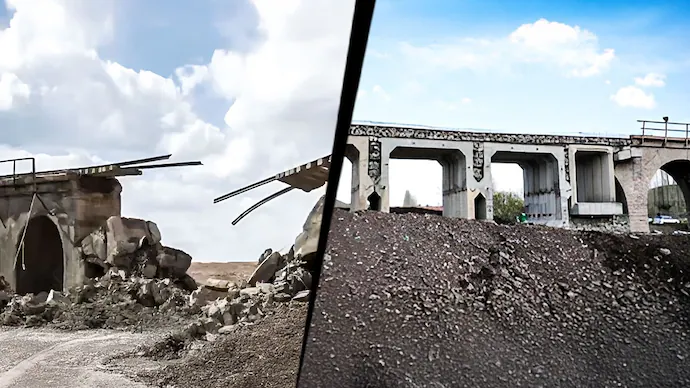
The US and Israel targeted bridges and railway tracks in an effort to cripple Iran’s transport network. Tehran, however, claims it restored key rail links within days, showcasing both resilience and the commitment of its engineers. The pace of reconstruction, it suggests, could even outstrip the destruction itself.
During their conflict with Iran, the US and Israel broadened their air and missile strikes beyond primarily military targets to include critical civilian infrastructure such as major railway bridges and tracks. Both US President Donald Trump and Israeli Prime Minister Benjamin Netanyahu had issued stark warnings about crippling Iran’s transport and communication networks, with Trump repeatedly threatening to bomb bridges, power plants, and other infrastructure to push Iran ‘back to the Stone Age’. Despite this, Iran appears to be demonstrating a striking ability to rebuild rapidly.
Iranian embassies are spotlighting the speed of reconstruction in a way that appears to both challenge and mock the US and Israel. Since a fragile ceasefire came into effect on April 8, Iranian officials say several damaged rail lines and bridges have been restored in record time – often within 40 to 96 hours – using domestic engineering teams. These efforts have been widely amplified through Iranian diplomatic accounts on X.
Railways continue to play a crucial role in transporting large numbers of passengers and heavy freight across long distances, making them prime targets in modern warfare. During the Vietnam War, for instance, US forces repeatedly targeted rail hubs in North Vietnam to disrupt supply lines from China. Much like Vietnamese crews who demonstrated remarkable resilience by repairing damage under fire, Iranian teams today appear to be exhibiting similar determination and speed in restoring their battered rail network.
Iran Reports Rapid Recovery of Damaged Infrastructure
In recent days, authorities have begun rebuilding bridges, railway lines and other infrastructure damaged during nearly 40 days of fighting.
According to a report by AFP, Iran has already resumed rail services on several key rout es after repairing sections hit in US and Israeli strikes.
In the northwestern Azerbaijan region, railway director general Alireza Soleimani told Iran’s IRNA news agency that trains from Tabriz to Tehran and Mashhad in the northeast have restarted operations.
‘These services resumed after a disruption of four to five days,’ Soleimani said, adding that the Tehran-Tabriz-Van route has also reopened, with a train departing for Van in Turkey using newly restored tracks.
Meanwhile, a major railway bridge near Qom, south of Tehran, was reopened on Saturday after reconstruction completed in less than 40 hours, according to Khosrow Samari, deputy governor of Qom province, speaking to Tasnim news agency.
Tasnim also released footage on Friday showing a train crossing the Yahya Abad bridge in Kashan, in central Isfahan province. The agency reported that the first train passed over the bridge following rapid repairs, after it was damaged in a US-Israeli strike earlier in the week.
In Tehran, AFP reported that authorities swiftly cleared debris from sites hit in the strikes, at times draping heavily damaged buildings with Iranian flags. Government spokesperson Fatemeh Mohajerani told reporters at a press conference on Sunday that rebuilding efforts could take anywhere from three months to two years.
She also noted that more than 125,000 buildings have been damaged since the conflict began – most of them residential – along with schools, hospitals and other civilian facilities.
Iranian Diplomatic Accounts Highlight Rapid Reconstruction Efforts
Iranian embassy social media accounts have actively amplified these developments on X, frequently sharing videos of reconstruction work and highlighting the country’s self-reliance.
On Monday, Iran’s embassy in Bulgaria posted that all six railway sites struck in US–Israeli attacks had been restored, stating that engineers rebuilt the bridges in under 96 hours and that train services had fully resumed, alongside video footage of the restored operations.
The same account had earlier shared a video of the Charbagh railway bridge reconstruction on April 11, describing it as an ‘extraordinary’ effort following a US-Israeli strike. It highlighted the speed, precision and coordinated teamwork involved, noting that the Charbagh bridge was restored and brought back into service within just 72 hours.
In another April 11 post, the Iranian Embassy in Bulgaria highlighted ongoing reconstruction work near Qom, describing it as the rebuilding of the ‘third destroyed railway bridge.’
Meanwhile, the Iranian Embassy in the UK shared a video and photo on Monday, stating: ‘How long does it take to build a bridge? In Iran: 40 to 100 hours,’ referring to the reconstruction of a second bridge following attacks by the United States and Israel.
In a post on Tuesday, the Iranian Embassy in Bulgaria also highlighted efforts to restore energy infrastructure, stating that while some countries rely on foreign experts, Iran is rebuilding with its own workforce.
The post cited Deputy Oil Minister Mohammad Sadegh Azimifar, who said plans are in place to restore 70–80% of capacity within one to two months. It also noted that around 2,000 workers at the Shahr Rey oil depot have begun repair work following reported strikes on the facility.
Why Iran’s Fast-Track Reconstruction Efforts Matter
In the days leading up to the ceasefire, Iran’s railway network emerged as a key target for both US and Israeli military planners. On April 7, US President Donald Trump said American forces would strike bridges and power plants across Iran.
According to The Times of Israel, the Israeli Defence Forces (IDF) targeted eight railway bridges and sections of roads allegedly used to transport weapons and military equipment. The strikes hit critical infrastructure across multiple regions, including Tehran, Karaj, Tabriz, Kashan and Qom.
Despite these attacks on major rail links, Tehran has demonstrated a notable capacity to repair essential infrastructure even during the conflict. Iranian authorities claim that within 100 hours of the strikes, six of the eight damaged railway sites were restored to normal operations.
However, with Trump indicating on Wednesday that he is not inclined to extend the ceasefire beyond its initial two-week duration – and with prospects for a lasting peace deal appearing slim – the possibility of renewed hostilities between Tehran, Washington and Jerusalem remains high. Any future escalation is likely to focus even more heavily on critical logistical networks such as railways, bridges, viaducts and ports.
In such a scenario, Iran’s ability to rapidly restore damaged infrastructure could prove more crucial than ever.