
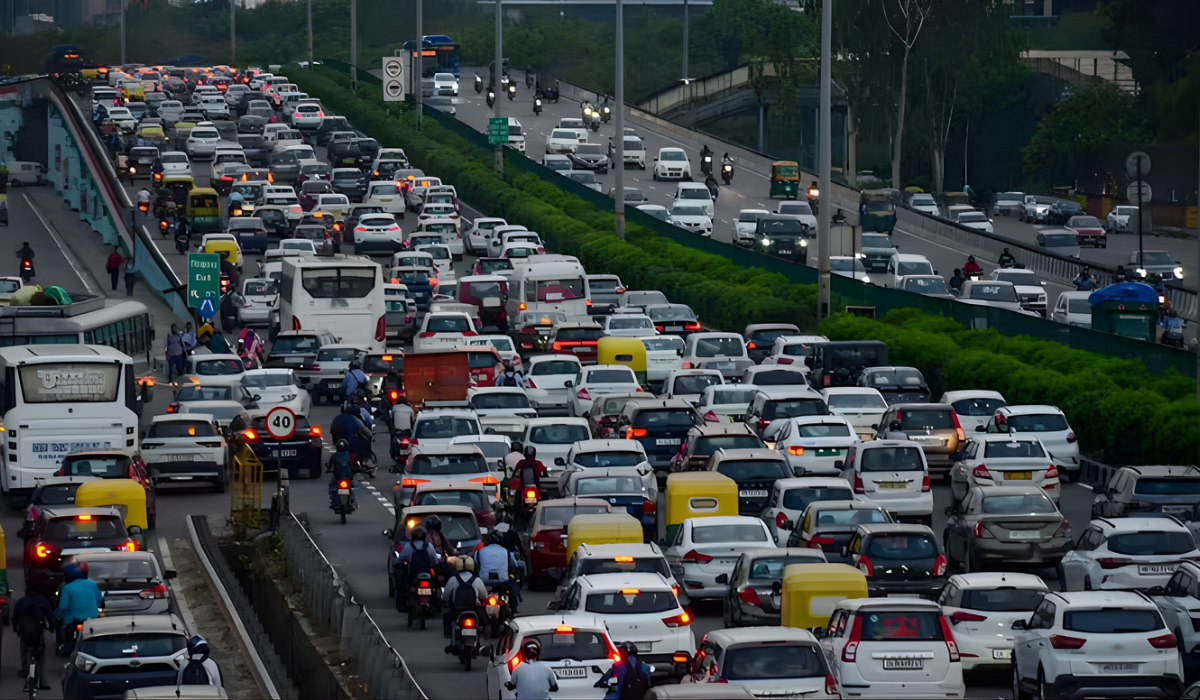
The promise is appealing: a “15-minute commute” enabled by signal-free corridors, expansive multi-lane flyovers, and a smooth, uninterrupted link between Gurugram and Delhi.
For a city currently burdened by severe gridlock – where peak-hour speeds rarely exceed 30 kmph, a Delhi-to-Gurugram commute often takes up to 90 minutes, and Gurugram continues to feature among India’s top 10 most congested cities, according to the TomTom Traffic Index 2025 – such large-scale infrastructure projects are being presented as the ultimate solution to urban congestion.
Here’s a clear and polished rephrased version:
Gurugram’s population has grown sharply, rising from 1.5 million in 2011 to over 3 million today, yet only around 12–15% of residents regularly rely on public transport.
The majority continue to crowd the same overburdened roads each day in private cars, taxis, and autos. Despite investing billions in expanding road infrastructure, a fundamental reality remains – backed by decades of transport economics and global urban experience: traffic congestion cannot be solved simply by building more roads.
The core flaw in the current approach stems from a misunderstanding of how traffic works. Expanding road capacity doesn’t just accommodate existing vehicles – it encourages more to enter the system.
This phenomenon, often called the “Iron Law of Congestion,” suggests that for Gurugram to truly improve, it must stop viewing roads as the solution and start recognising them as a key contributor to the problem.
The Myth of Fixing Traffic: Understanding Induced Demand
A common misconception in urban planning is that traffic behaves like a liquid – flowing more smoothly when roads are widened. In reality, it behaves more like a gas, expanding to fill any available space, a concept known as induced demand.
Research strongly supports this. A landmark study on California’s highway network found that a 10% increase in road capacity resulted in roughly a 9% rise in traffic within four years, effectively cancelling out the added capacity.
Similarly, a 2004 meta-analysis of multiple studies concluded that a 10% increase in lane miles leads to full utilisation by additional traffic within a few years. As travel becomes faster and more convenient, people tend to shift from public transport to private vehicles, undertake longer journeys, or relocate farther from their workplaces – causing congestion to return to previous levels.
Braess’s Paradox reinforces this idea: adding new roads can sometimes make overall traffic worse. While drivers choose routes that seem optimal individually, their collective decisions can reduce the efficiency of the entire network.
On the other hand, the concept of “traffic evaporation” shows the opposite effect. A 1998 UK study of 100 locations found that reducing road space for private vehicles led to an average 25% drop in overall traffic.
In fast-growing cities like Gurugram, signal-free corridors often push large volumes of vehicles into narrower bottlenecks further ahead. Rather than solving congestion, such measures simply shift it elsewhere.
The Hidden Challenge: Logistics and Freight Pressure
While private cars dominate the visible picture of congestion, the underlying burden of India’s logistics system plays a quieter but equally critical role.
Around 70% of the country’s freight is transported by road (NITI Aayog, 2022), with logistics costs accounting for 13–15% of GDP – among the highest globally. In Gurugram, as in many major Indian cities, heavy freight vehicles and daily commuters use the same corridors, pushing an already strained system toward saturation.
Studies of transport patterns across 45 major Indian cities reveal a persistent dependence on road-based freight, alongside a steady decline in rail’s share – from about 50% of long-distance freight in 2008 to nearly 32% by 2022.
Each tonne of cargo shifted to rail means one less truck on NH-48. Without this transition, road expansion serves only as a cosmetic solution to an underlying structural issue.
Global Best Practices: Reallocation Over Expansion
The cities that have reduced congestion most effectively have done the unexpected: they removed road space. In Paris, Mayor Anne Hidalgo’s push to reallocate streets for cycling and public transport led to a 14% reduction in traffic jams and a 4% fall in traffic, without shifting congestion elsewhere.
London’s investment in Low Traffic Neighbourhoods and cycling infrastructure has led to a 43% increase in daily cycling trips since 2019, along with a 35% decline in road deaths and injuries.
The takeaway from both cities is clear: when driving becomes less convenient and alternative options improve, people adjust—and urban mobility improves.
While Gurugram faces its own challenges in terms of culture, infrastructure, and governance, these global examples offer valuable guidance for developing local solutions.
For instance, space can be reallocated for cycle tracks and dedicated bus lanes through pilot projects in high-traffic commercial areas, supported by community engagement to address local needs and build public support. Rather than directly copying European models, Gurugram can adapt their core principles through a gradual, context-sensitive approach that reflects the city’s unique conditions.
The Real Cost Behind “Signal-Free” Corridors
The promotion of signal-free corridors hides their broader costs. High-speed urban roads create unsafe conditions for pedestrians and cyclists; on stretches like NH-48, where last-mile travel on foot is unavoidable, the lack of safe crossings is not merely inconvenient – it can be life-threatening.
Beyond safety concerns, flyovers and grade separators act as physical barriers, dividing neighbourhoods and eroding the walkable environments that are essential to vibrant urban life.
Perhaps most paradoxically, road expansion that sidelines public transport ultimately backfires. The Downs–Thomson Paradox suggests that when buses and metro systems are neglected, car speeds fall to match the inefficiency of public transit. Widen the roads while ignoring buses, and congestion returns – worse than before.
A New Mobility Roadmap for Gurugram
The way forward isn’t complex – it calls for clear, thoughtful leadership. Gurugram needs air-conditioned electric buses running on dedicated lanes, seamlessly integrated with the metro and supported by reliable last-mile connectivity, designed to be faster and more comfortable than private vehicles.
The city also requires continuous, shaded, and protected footpaths and cycle lanes that are genuinely usable – not squeezed into leftover spaces. Alongside this, there must be honest demand management through market-based parking, congestion pricing, and a shift away from the notion that road space is a free entitlement for private vehicle owners.
These measures are not radical; they are proven solutions adopted by cities that have overcome congestion. The real question is whether Gurugram’s policymakers are ready to prioritise people over cars.
Road expansion is an outdated approach. What Gurugram needs is not more room for vehicles, but better mobility for its people.
A sustainable, Atmanirbhar Haryana calls for a decisive shift: 1,000 air-conditioned electric buses and seamless metro connectivity to Dwarka, Sohna, Manesar, and Faridabad. This is not just infrastructure – it is an investment in economic productivity, cleaner air, and equitable access for all residents, not only those who own cars.
Having spent over two decades walking, cycling, and advocating on these streets, I have seen infrastructure promises come and go – and I know what truly works: dependable buses, safe footpaths, and streets designed for people, not vehicles.
Every flyover built instead of a bus lane reflects a choice about who the city is designed for. It’s time to choose differently – to stop planning for congestion and start building a future that is efficient, inclusive, and genuinely self-reliant.