
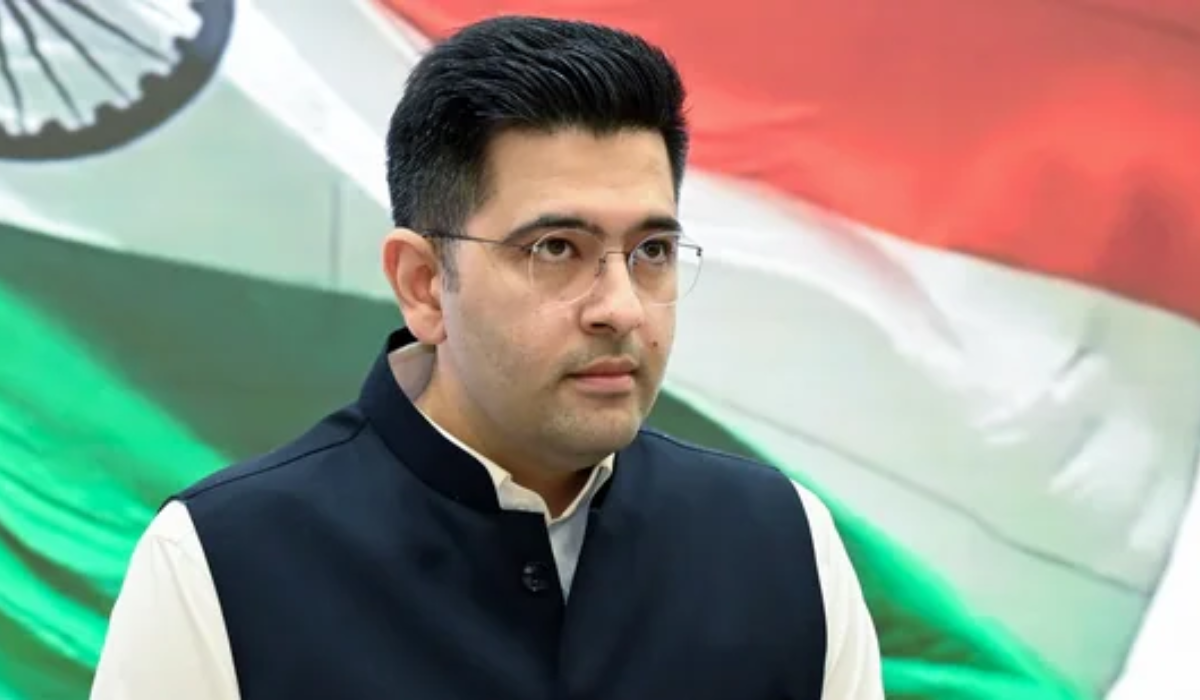
Days after a public fallout with the Aam Aadmi Party, Rajya Sabha MP Raghav Chadha left the party he co-founded and “merged” with the ruling Bharatiya Janata Party. The use of the term “merged” is significant, as resigning individually would have led to his disqualification from the Rajya Sabha under the anti-defection law.
Under the Constitution’s Tenth Schedule, a Rajya Sabha member can avoid disqualification under the anti-defection law only if at least two-thirds of their party’s legislators agree to merge with another party.
Raghav Chadha highlighted this in a post on X, stating, “We, two-thirds of the Members of Parliament from the Aam Aadmi Party in the Rajya Sabha, will invoke constitutional provisions to merge with the Bharatiya Janata Party.”
The AAP currently has 10 Rajya Sabha MPs, of whom seven have now joined the move, Chadha announced, standing alongside Sandeep Pathak and Ashok Kumar Mittal. He added that he also had written support from four more MPs backing the formation of a bloc and the merger with the BJP.
The group includes Chadha himself, along with Mittal – recently appointed deputy leader of AAP in the Rajya Sabha – Sandeep Pathak, Harbhajan Singh, Rajinder Gupta, Vikramjit Singh Sahney, and Swati Maliwal.
The three members who continue to remain with the Aam Aadmi Party are Sanjay Singh, Balbir Singh Seechewal, and N. D. Gupta.
Of the seven MPs who have switched sides, six are from Punjab. They were elected in 2022 after the Aam Aadmi Party secured a sweeping majority in the state’s Assembly elections.
This effectively leaves the Aam Aadmi Party with just one Rajya Sabha MP from Punjab – environmentalist and spiritual leader Balbir Singh Seechewal.
The development is a significant setback for the state’s ruling party, especially with the Punjab Assembly elections less than 10 months away.
All the MPs involved hold six-year Rajya Sabha terms that run until April 2028.
Swati Maliwal exits the Aam Aadmi Party
The seventh to exit is Swati Maliwal from Delhi, who has been publicly at odds with the Aam Aadmi Party leadership since 2024 but had not resigned earlier, as doing so would have cost her Rajya Sabha membership. The party, too, did not expel her, since she would have retained her seat regardless.
Maliwal required the support of two-thirds of AAP members in the House to avoid disqualification – something that became possible once Raghav Chadha and others joined together in the move. Her current term runs until 2030.
Who Left and Who Stayed
Brief profiles of the Aam Aadmi Party Rajya Sabha MPs who switched to the Bharatiya Janata Party show that many come from non-political or business backgrounds.
Raghav Chadha and Swati Maliwal are activists who were part of AAP’s founding team in 2012, emerging from the anti-corruption movement led by Anna Hazare.
Sandeep Pathak, who served as the party’s national general secretary, was credited – along with Chadha – for the party’s victory in Punjab. However, his nomination to the Rajya Sabha from the state drew criticism, with some viewing him as an “outsider.”
Chadha, though of Punjabi origin, is based in Delhi and was similarly perceived by some as an outsider being preferred over local Punjabi leaders.
Former Team India cricketer Harbhajan Singh has largely remained a non-political figure, even as the Aam Aadmi Party projected his Rajya Sabha nomination as recognition for a prominent face from Punjab’s politically significant Doaba region, particularly Jalandhar. However, he has mostly stayed away from political debates, apart from occasional social media exchanges on national issues.
Mittal Also Joins the Exit
Industrialist Ashok Kumar Mittal, who replaced Raghav Chadha as the AAP’s Rajya Sabha deputy leader – a move that marked a visible rift within the party – has also joined the Bharatiya Janata Party. Mittal, founder of Lovely Professional University and owner of multiple business ventures, was recently raided by the Enforcement Directorate (ED) over alleged irregularities in his income sources, a move the party described as political pressure.
Vikramjit Singh Sahney is known as an industrialist and philanthropist. Though primarily based in Delhi, he has been actively involved in social initiatives across Punjab.
Rajinder Gupta of the Trident Group, headquartered in Ludhiana, is another business figure. He was elected to the Rajya Sabha in a by-election in October 2025, following the move of Sanjeev Arora to the state assembly, where he later became a minister in the Bhagwant Mann government.
Sandeep Pathak, an IIT graduate-turned activist-politician like Arvind Kejriwal, served as the party’s in-charge for Punjab.