
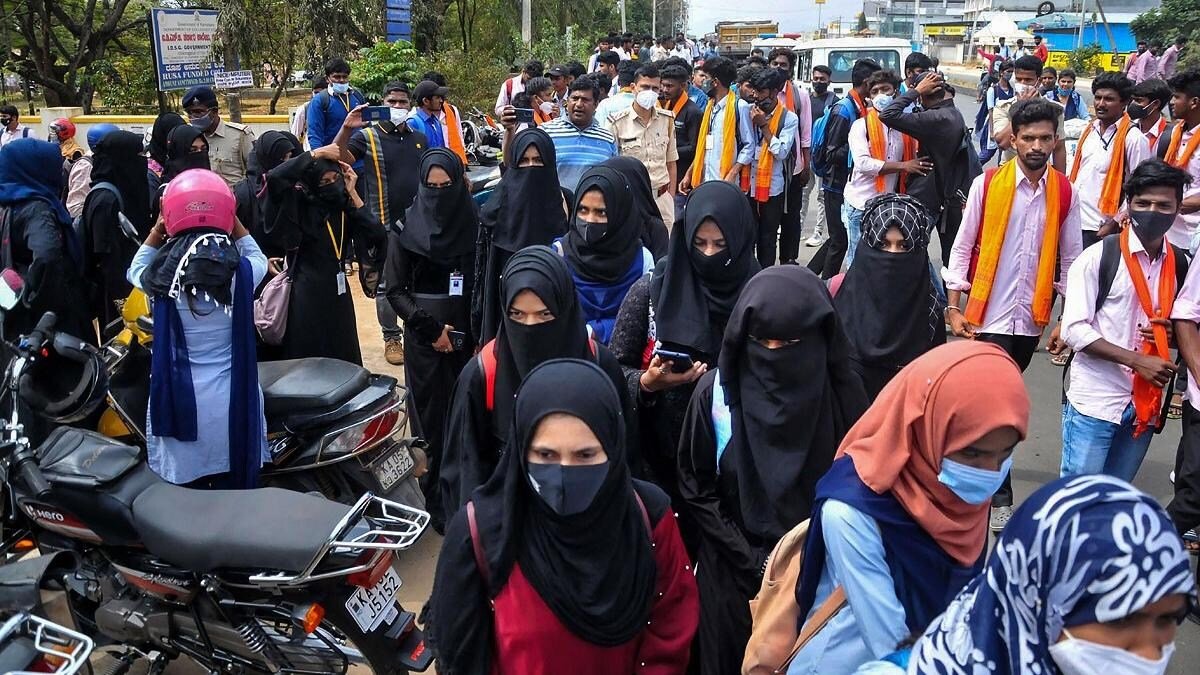
Tension has flared up again at a government college in Karnataka’s Haveri district after a fresh face-off between students over hijabs and saffron shawls, reviving memories of the wider hijab controversy that rocked the state in recent years. The situation has prompted the college administration and local authorities to move into damage-control mode and appeal for calm among students.
What happened on campus:
At CG Bellad Government First Grade College in Akki Alur, a group of Hindu students walked into classrooms wearing saffron shawls, saying they were protesting against some Muslim girl students attending classes in hijabs despite a prescribed uniform. Students claimed they had been urging the principal for almost a month to strictly implement the dress code and bar religious attire inside classrooms, but alleged that no firm action was taken.
In response, Muslim students continued to assert their right to wear the hijab while remaining in the college uniform, which turned the disagreement into a visible standoff on campus. The opposing displays of hijabs and saffron shawls led to heated arguments and a charged atmosphere, though no major violence has been reported so far.
College administration’s response:
Principal Viresh Kammoor has reiterated that the college rule requires all students to follow a common uniform inside classrooms, with limited exceptions handled on a case-by-case basis. He has said that after a girl attended class in a hijab, some boys turned up in saffron shawls the next day, escalating a matter that the administration is now trying to resolve through dialogue.
College authorities have decided to hold meetings with staff, parents and student representatives to de-escalate tensions and clarify the dress code. In a bid to reduce further provocation and social media circulation of campus visuals, the college has also moved to curb mobile phone use, a step that has itself drawn criticism from sections of the students.
Link to the larger hijab debate:
The stand-off in Haveri echoes the statewide hijab row that began in 2022, when disputes over wearing the hijab in classrooms spread across several Karnataka institutions. At that time, groups of Hindu students in some colleges had similarly adopted saffron scarves in protest, demanding a strict, religion-neutral dress code.
The previous state government had issued an order insisting on uniforms where prescribed, and the issue eventually reached the courts, which examined whether bans on religious attire violated constitutional rights. The latest flashpoint in Haveri shows how the hijab–saffron shawl question remains politically and socially sensitive, especially in mixed campuses where questions of identity, equality and institutional rules intersect.
Key concerns going forward:
Parents and educators in the region are worried that repeated flare-ups could disrupt academic activity and deepen communal divisions among young students. Local stakeholders are urging that any decision on dress codes balance institutional discipline with sensitivity to religious beliefs, and be communicated clearly to avoid further confrontations.
Authorities are also under pressure to ensure that the campus does not become a stage for external political mobilization, something that was widely flagged during the earlier statewide hijab protests. For now, all eyes are on whether talks at the Haveri college can defuse tensions and produce a consensus-based approach that keeps classrooms focused on academics rather than identity-driven conflict.
For more details and the fastest updates, follow us on @namma.updates. Stay informed and stay connected.