
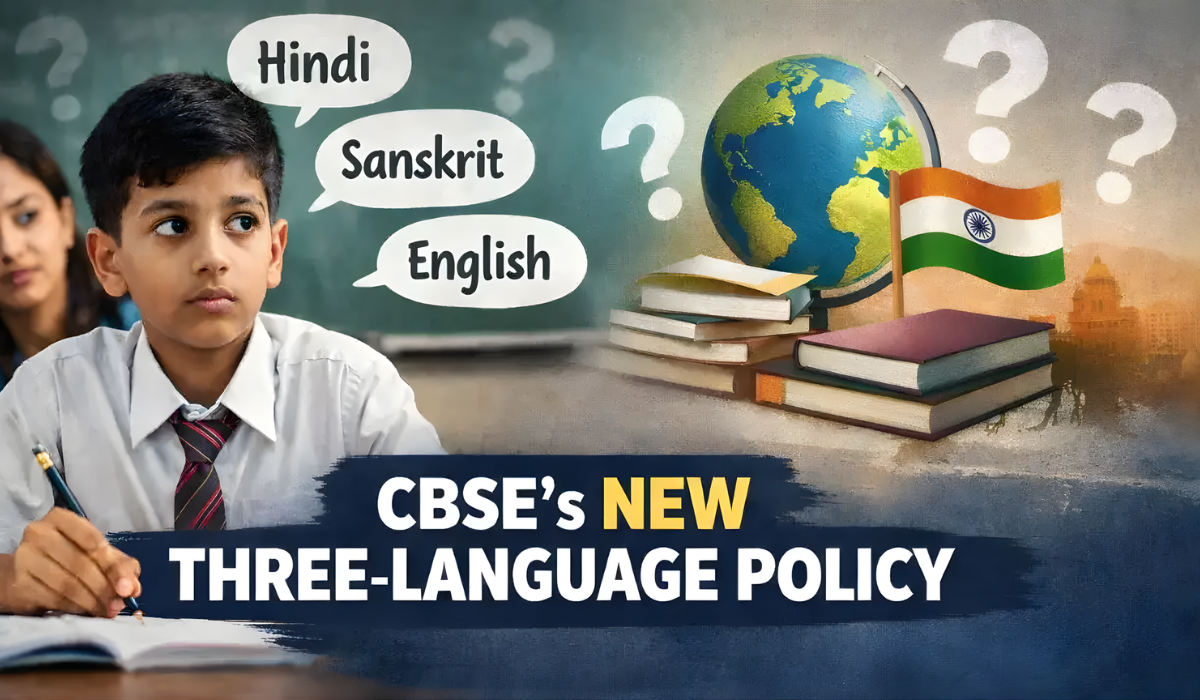
Under Central Board of Secondary Education’s revised 2026–27 framework, the three-language system – R1, R2, and R3 – will become mandatory from Class 6 and will be gradually extended up to Class 10. The first batch impacted by this change is expected to appear for board examinations in 2030-31.
Unlike R1 and R2, R3 is likely to remain a school-level subject assessed internally, rather than being included as a separate paper in the Class 10 board exams.
Across many English-medium Central Board of Secondary Education schools, a clear trend is emerging – Sanskrit is increasingly being seen as the easiest choice for the third language.
Not necessarily because families asked for it, but often because schools already had Sanskrit teachers, established systems in place, and faced fewer logistical challenges compared to introducing languages like Tamil, Bengali, Marathi, Punjabi, or others.
In effect, a policy intended to promote diversity is, in some cases, resulting in a single default choice.
Why Sanskrit is becoming the go-to language in schools
There is also a deeper institutional factor at play. In many Central Board of Secondary Education schools, Sanskrit was already part of the middle-school curriculum under earlier three-language models – particularly in Classes 6 to 8 using resources like NCERT’s Deepakam. As a result, many schools already had trained teachers, established timetable slots, and existing administrative systems in place.
That legacy now gives Sanskrit a clear edge in the new rollout. Since many schools can adopt it more quickly than regional languages with limited staffing, the classical language is shifting from a middle-school option to a widely used, compliance-friendly choice.
In many English-medium schools, where Hindi already fulfills one of the required Indian languages and English serves as the only “foreign language,” Sanskrit has emerged as the simplest and most convenient option for R3.
At Silverline Prestige School, Principal Dr Gita Joshi said the transition was smooth as the necessary framework was already in place.
“The rollout of the third-language requirement was seamless for our school, as Sanskrit was already included as the third language in our curriculum,” she said.
“This existing setup meant that no major structural changes were required.”
A similar trend can be seen in other places as well.
At Modern Public School, Principal Dr Alka Kapur said the rollout was managed by “reorganising the timetable to include dedicated periods for Sanskrit, Hindi and English.”
She added that the school made sure “the overall balance of instructional time remained unaffected.”
For many schools, that’s the core issue: where Sanskrit was already in place, the transition was relatively smooth; where it wasn’t, the shift proved more challenging.
Dr Gita Joshi said Sanskrit was selected based on “both pedagogical vision and existing logistical strengths.”
She explained that, from a logistical standpoint, Sanskrit was already seamlessly integrated into the curriculum, supported by qualified teachers, structured textbooks, and dedicated timetable slots.
The staffing challenge schools can’t ignore
One of the biggest concerns surrounding the policy is straightforward: who will teach these languages?
Some schools say they were already equipped to handle the change.
Dr Alka Kapur said the school did not need to recruit new teachers, as language faculty were already in place.
She added that existing staff were reassigned and their schedules adjusted accordingly.
Dr Gita Joshi said that Silverline Prestige School also did not require any urgent hiring.
She said the school did not need to recruit new language teachers or reassign existing staff.
She added that their Hindi teachers are also proficient in Sanskrit.
That may sound reassuring, but it also highlights why Sanskrit is emerging as the easiest option – schools are opting for what they can staff immediately.
Even Manav Rachna International School, while more cautiously phrased, acknowledged that smaller institutions may face “staffing shortages” and “timetable inflexibility.”
Foreign languages aren’t disappearing, but they’re being phased out
The second change concerns what is being pushed aside.
Several private schools had developed strong programmes in French, German, or Spanish. While these languages may continue, they are increasingly being moved outside the core academic structure.
Modern Public School said that foreign languages such as German and French will continue to be offered by existing staff as extracurricular activities.
That distinction is important – a language club is not equivalent to a formal subject with grades, dedicated class periods, and sustained continuity.
At Manav Rachna International School, teacher Tanu Chawla said French and Spanish would continue to be offered through enrichment sessions rather than formal assessment.