
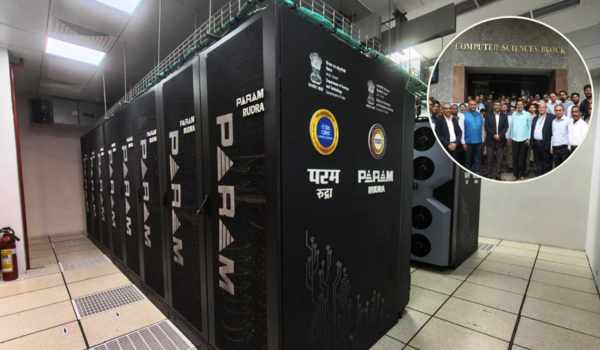
The system was developed and deployed by C-DAC under the National Supercomputing Mission (NSM), jointly led by MeitY.
The Ministry of Electronics and Information Technology (MeitY) has inaugurated PARAM SHAKTI, a new supercomputing facility at the Indian Institute of Technology Madras (IIT Madras), which houses the indigenous PARAM RUDRA system. The facility was formally launched on January 3, 2026, by MeitY Secretary S. Krishnan, according to an official statement.
The supercomputing system has been developed and deployed by the Centre for Development of Advanced Computing (C-DAC) under the National Supercomputing Mission (NSM), a flagship initiative jointly led by MeitY and the Department of Science and Technology (DST).
PARAM SHAKTI is powered by the PARAM RUDRA supercomputing cluster, built on C-DAC’s indigenously designed RUDRA series servers. The system offers a peak computing performance of 3.1 petaflops, enabling it to carry out more than 3.1 quadrillion computations per second. Officials said the facility has been entirely designed and manufactured in India and operates on open-source platforms, including AlmaLinux, along with a system software stack developed in-house by C-DAC.
In addition to computing capabilities, the facility features integrated infrastructure such as uninterrupted power supply, advanced cooling mechanisms, and dedicated data centre operations to ensure continuous high-performance workloads.
According to IIT Madras, access to such advanced computing resources is expected to significantly boost research across a wide range of fields, including aerospace engineering, materials science, climate modelling, combustion research, molecular dynamics, nuclear sciences, and drug discovery. The system allows researchers to conduct large-scale simulations, reducing reliance on lengthy experimental processes and accelerating research outcomes.
Faculty members and researchers at IIT Madras are already utilising the facility for simulations across multiple spatial and temporal scales, ranging from sub-atomic electronic structure calculations to large-scale structural and system-level analyses, the statement added.