
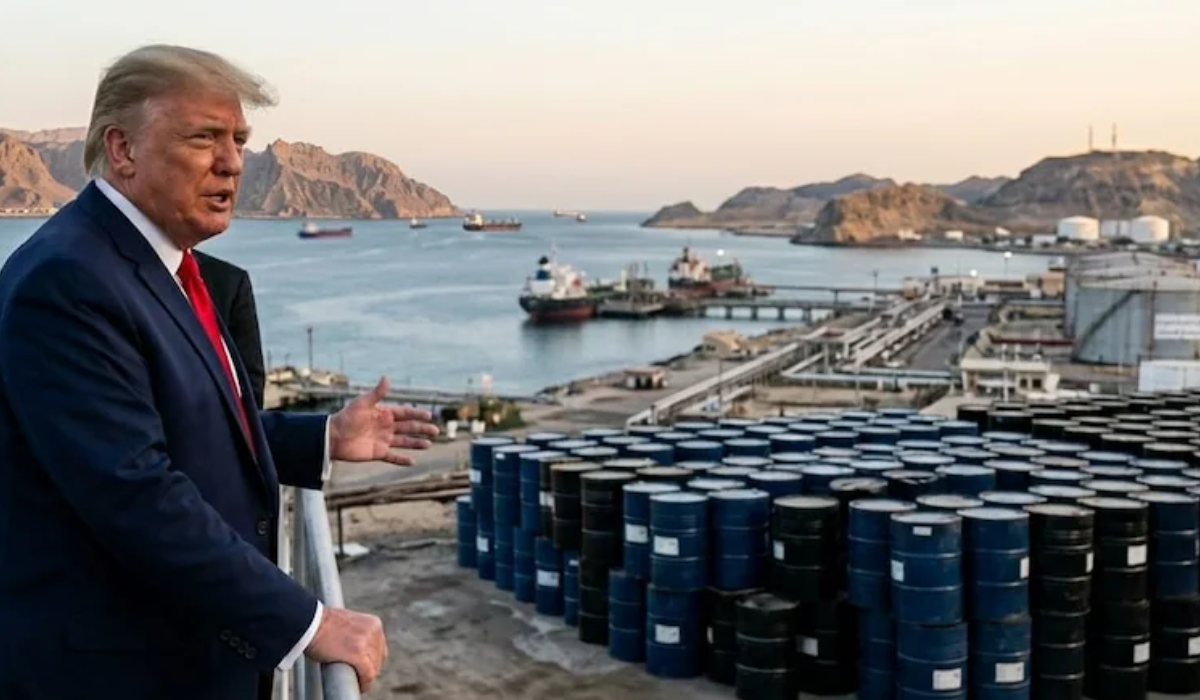
US President Donald Trump has temporarily paused “Project Freedom,” the US military operation aimed at helping stranded ships navigate through the Strait of Hormuz as Washington moves closer to finalizing a deal with Iran. However, Trump clarified that the US blockade on Iranian ports will continue despite ongoing progress in negotiations to end the conflict.
“Significant progress has been achieved toward a full and final agreement with representatives of Iran,” Trump wrote in a post on Truth Social.
Donald Trump said the operation was being paused temporarily to allow Washington more time to finalize a settlement with Iran, despite a recent rise in military activity in the region.
“Following requests from Pakistan and several other countries, along with the major military success achieved during the campaign against Iran and the significant progress made toward a complete and final agreement with Iranian representatives, we have jointly decided to temporarily pause Project Freedom. However, the blockade will remain fully active while efforts continue to finalize and sign the agreement,” he said.
Operation Epic Fury Is Now Over
The announcement came just hours after military officials and US Secretary of State Marco Rubio stated that the Middle East ceasefire remained intact and that, although the conflict had not fully ended, the first phase of the major US military campaign against Iran had been completed.
“The operation has concluded. ‘Epic Fury’ – as President Donald Trump informed Congress – has completed that phase of the mission,” Marco Rubio said.
He echoed the remarks of Washington’s top military official, who earlier stated that US forces were prepared to resume combat operations if directed. However, Marco Rubio stressed that lasting peace would require Iran to accept President Donald Trump’s conditions on its nuclear programme and agree to reopen the Strait of Hormuz, a crucial route for global energy supplies.
As these developments unfolded in Washington, Iranian media reported that Foreign Minister Abbas Araghchi had arrived in Beijing for talks with Chinese Foreign Minister Wang Yi.
Marco Rubio also voiced hope that Beijing would urge Tehran to end its blockade of the Strait of Hormuz during Araghchi’s visit. He argued that China stands to lose more than the US from disruptions in the strait, noting that China’s export-driven economy heavily relies on shipping routes passing through Hormuz.
“It is in China’s interest for Iran to stop blocking the strait,” Rubio said.
When asked about international support for the US-led mission to reopen the waterway, Rubio said the challenge was not a lack of willingness, but a shortage of military capability among other nations. “Many countries would like to help, but they lack the naval strength or the ability to deploy forces there quickly,” he said.
Rubio added that the responsibility largely falls on the United States because it is the only country capable of projecting military power effectively in that region. “Project Freedom is primarily a US responsibility because we are the only nation that can operate at that scale in that part of the world,” he said, adding, “This is a service to the global community, as it is their ships that remain stranded.”
The Strait of Hormuz Crisis
Under “Project Freedom,” US military escort operations over the past 36 hours reportedly came under Iranian attack, further straining an already fragile ceasefire.
Iran’s Revolutionary Guards Navy warned that any vessel departing from Tehran-approved routes through the Strait of Hormuz would face a “firm response,” while Iran’s chief negotiator said Tehran “had not even started yet” following a series of incidents along the key global trade corridor.
Meanwhile, the United Arab Emirates claimed for a second consecutive day that it had intercepted multiple Iranian missiles and drones. Tehran, however, strongly rejected the allegation.
“The armed forces did not carry out any missile or drone operations,” Iran’s Khatam al-Anbiya Central Headquarters said in a statement.