
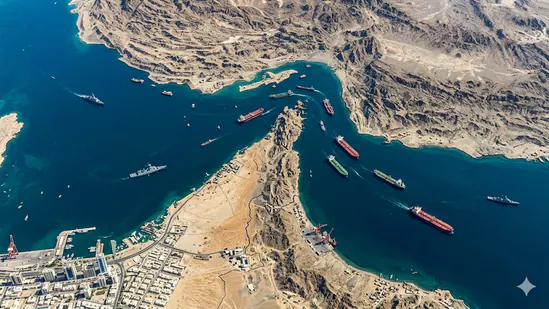
Former Israeli government spokesman Eylon Levy has cautioned that the already fragile US-Iran ceasefire could collapse as Tehran refuses to reopen the Strait of Hormuz.
Speaking to ANI, Eylon Levy described Iran’s conduct as “maritime piracy,” accusing the Islamic Republic of effectively holding the global economy hostage in an attempt to pressure the international community.
He added that a key pillar of the diplomatic agreement was the free and uninterrupted movement of ships through the Strait of Hormuz—an assurance he says Tehran has already failed to uphold.
“The US-Iran ceasefire remains fragile because the Islamic Republic is refusing to reopen the Strait of Hormuz as promised. It continues to behave like a pirate at sea, blocking vessels from entering or leaving the waterway and holding the global economy hostage to coerce the United States and others. Iran must reopen the Strait of Hormuz. This blockade violates international law and is entirely unacceptable,” he said.
Levy stressed that the current understanding between the United States and Iran offers no protection to Hezbollah in Lebanon. He asserted that Israel, as a sovereign nation, will not allow others to dictate or negotiate its security.
After a month in which Hezbollah launched around 7,000 missiles, rockets, and drones—including a ballistic missile aimed at Tel Aviv—Levy argued that military action is necessary to safeguard communities in northern Israel.
He said that Lebanon is not included in the ceasefire, and the United States has made it clear that it never assured Israel would refrain from acting against Hezbollah. He added that, as a sovereign nation, Israel will make its own decisions on matters of war and peace.
He explained that Israel’s current actions against Hezbollah are a response to continuous attacks, noting that Iran-backed forces in Lebanon have launched around 7,000 missiles, rockets, and drones at Israel over the past month. He also mentioned being awakened at 2 a.m. due to a ballistic missile strike targeting Tel Aviv.
He emphasized that Israel remains committed to eliminating the threat posed by Hezbollah near its northern border, where civilians are highly vulnerable.
In a notable diplomatic shift, Levy said that Israel has expressed willingness to engage in direct peace talks with the Lebanese government, with the aim of jointly dismantling Hezbollah rather than settling for a “simple ceasefire” that leaves the group intact.
He added that just as India would not tolerate a foreign-backed militant group attacking its borders and displacing civilians, Israel is also unwilling to accept such a situation. According to him, Israel has made it clear it prefers comprehensive peace negotiations over a temporary ceasefire that could prolong the conflict, emphasizing a collaborative approach with Lebanon to address the Hezbollah threat.
Levy further stated that the broader objective is for Lebanon to eventually follow the example of the UAE, Bahrain, and Morocco by normalizing ties with Israel and moving away from the era of proxy forces.
He said Israel believes it should have peace with Lebanon and that global leaders should urge Lebanon to recognize Israel, accept the established border, join the Abraham Accords, and prevent Hezbollah – described as an Iran-backed proxy force – from launching attacks on Israeli civilians from its territory. He stressed that Israel is committed to removing the threat posed by Hezbollah and will not allow the prospect of talks to be used as a delay tactic while attacks continue.
Levy added that Israel is seeking a comprehensive peace framework that would enable both countries to address Hezbollah together. He argued that Israel’s military pressure has created both urgency and an opening for the Lebanese government to act against Hezbollah – something he claimed it has avoided for years. He expressed hope that Lebanon will accept Israel’s offer for direct peace talks, establish formal relations, and cooperate in dismantling what he described as a shared threat.
Levy said that Israel is seeking normalization with Lebanon and the complete neutralization of Hezbollah, emphasizing its desire for peaceful relations with its neighbor.
He stated that Israel wants a stable border and normal ties with the Lebanese government, ensuring that Lebanese territory is no longer used to launch attacks. The broader goal, he explained, is to expand regional peace. He noted that Israel has already normalized relations with Bahrain, the United Arab Emirates, and Morocco under the Abraham Accords, and hopes more countries in the Arab world will follow.
He added that Israel is also aiming for a comprehensive approach to address Iran’s nuclear program, missile capabilities, and network of proxy groups.
He said that achieving peace will require the Lebanese government to prevent armed attacks from its territory, stressing that Israel cannot allow border communities to remain exposed to missile and drone strikes without sufficient warning to seek shelter.
Levy added that the situation has escalated because the Lebanese government has not effectively addressed Hezbollah’s actions. He stated that Israel’s conflict with Hezbollah is driven by continued attacks involving missiles, drones, and rockets targeting Israeli civilians, while Lebanon has not intervened to stop them.
He emphasized that Israel’s priority is to ensure security for residents in northern areas so they can live without fear of attacks. He also described the situation as a long-standing failure by the Lebanese government, saying it has not taken decisive action against Hezbollah for decades.
Levy said that a UN resolution following the 2006 war required Lebanon to dismantle Hezbollah, but this was never carried out, allowing the group to build what he described as a large, well-armed force along Israel’s border. He added that after the October 7 attacks, Hezbollah joined Hamas in its conflict with Israel.
He further stated that although the 2024 war ended with another commitment by Lebanon to dismantle Hezbollah, that too was not implemented, and attacks on Israeli civilians resumed. According to him, this has forced Israel to deploy its soldiers to confront Hezbollah, arguing that the situation arose because Lebanon allowed its territory to be used by an armed group targeting Israeli communities.
Levy characterized the ongoing conflict as a “tragic” but necessary outcome of what he described as Lebanon’s prolonged failure to comply with UN resolutions aimed at disarming Hezbollah.
He described the situation in Lebanon as deeply tragic, saying it is unfortunate that matters have reached this point due to what he sees as the UN’s failure to effectively address the threat posed by Hezbollah. He expressed hope that the Lebanese government will act decisively to dismantle the group, prevent further threats to Israeli civilians, and help pave the way for lasting peace in the region.
Levy also said that Israel, as a close ally of the United States, is prepared to counter what he described as Iranian aggression, which he claims now poses a risk to cities across the Middle East, including Dubai and Abu Dhabi.
He added that Israel supports efforts to reach a broader agreement addressing what he called the “triple threat” from Iran – its missile capabilities, nuclear program, and network of proxy groups. According to him, this is a key priority not only for Israel but also for Gulf nations that have faced recent drone and missile attacks and are seeking more than a temporary ceasefire.
As delegations get ready to meet in Islamabad for ceasefire discussions, Levy called on the United States to maintain what he described as a “credible military threat.”
He said that if the talks fail due to Iran’s continued role in supporting militant activity and regional aggression, it is important for the US to keep the option of renewed military action open. He added that Israel would be ready to support the United States as a strong ally in countering what he described as Iranian attacks across West Asia.