
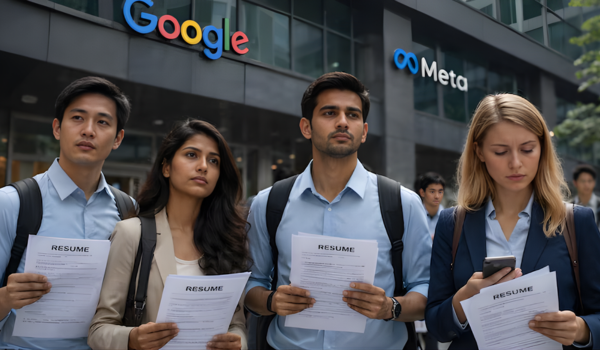
Big Tech companies are reportedly recruiting significantly fewer fresh graduates as artificial intelligence increasingly handles routine entry-level tasks. According to Ethan Choi, a partner at Khosla Ventures, the impact of AI-driven automation has been so pronounced that even computer science graduates from Stanford are finding it difficult to secure jobs in today’s AI-dominated market.
Artificial intelligence is increasingly reshaping the job market, with entry-level roles appearing to be the most affected. Companies are deploying AI tools such as Claude, GitHub Copilot, Codex, and other coding assistants to automate tasks that were once handled by junior professionals.
As a result, organizations are reallocating resources and reducing their intake of fresh graduates. According to Ethan Choi, a partner at Khosla Ventures, even Stanford computer science graduates – once considered among the most sought-after candidates – are now facing difficulties securing roles in the current AI-driven hiring landscape.
In a recent post on X, Ethan Choi reflected on the evolving job market, describing AI-driven hiring changes as a structural shift. He argued that the long-standing social contract of “go to college, get a job” is beginning to unravel. Entry-level roles – once viewed as essential stepping stones for graduates to develop judgement and domain expertise – are steadily diminishing. As AI tools grow more advanced and automate routine coding, documentation, analysis, and support functions, companies are reconsidering the need to recruit large numbers of junior employees.
“I’m meeting Stanford CS students who can’t get jobs right now,” he wrote on X. “I’m also constantly being asked what we should teach our children to help them survive and thrive in an AI-first world. Entry-level jobs were how we, as a society, converted education into ‘useful skills.’”
“We are heading into a structural mismatch between labor supply and demand, with few clear solutions,” he added. “The social contract of ‘go to college and get a job’ is breaking down, and as a society – along with our universities – we may be producing too many college graduates for the opportunities that now exist.”
Choi’s observations are consistent with broader reports highlighting a sharp decline in entry-level hiring, particularly within Big Tech. A recent Forbes report noted that the share of companies recruiting fresh graduates has dropped from around 25 per cent in 2023 to just 7 per cent currently. New college graduates now reportedly make up only about 7 percent of hires at major technology firms – down from roughly 25 percent in 2023 and more than 50 percent prior to the pandemic.
At the same time, some companies are reconsidering whether scaling back junior recruitment was the right move. IBM, for instance, has announced plans to increase entry-level hiring in the United States in 2026, despite earlier projections that AI would eliminate thousands of back-office roles.