
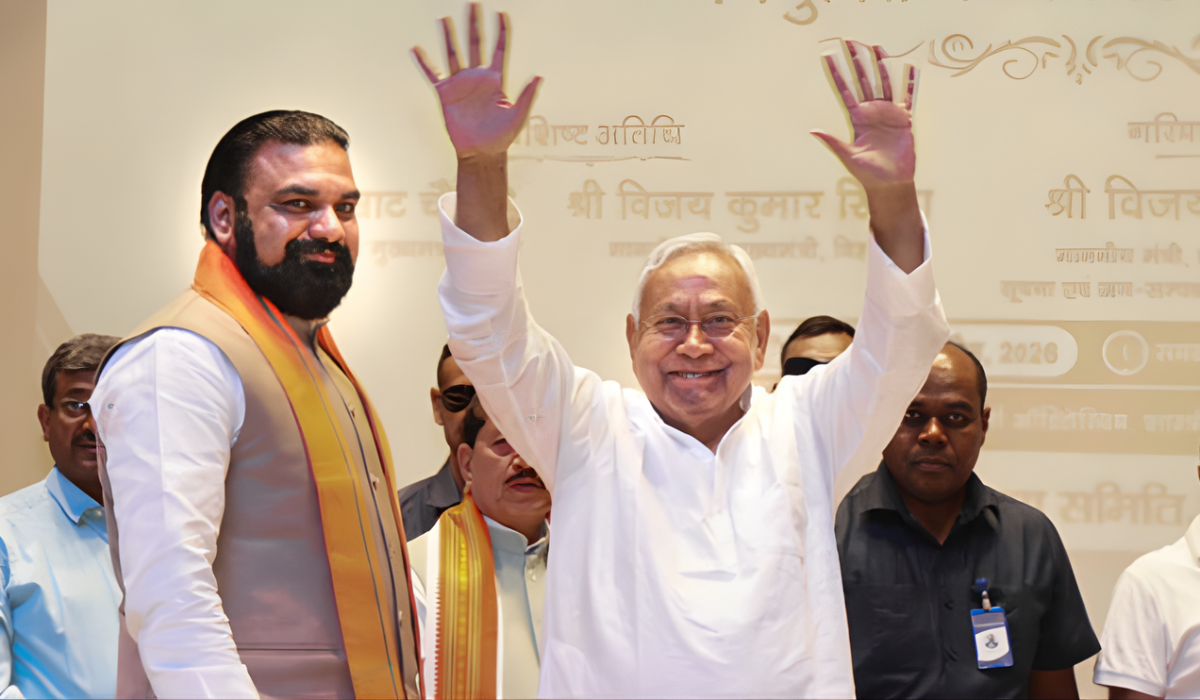
Sources told India Today that Nitish Kumar is expected to resign as Bihar Chief Minister on April 14, when the NDA legislative party is likely to meet to choose the next chief minister.
Nitish Kumar, the Janata Dal (United) supremo, is set to conclude his two-decade-long tenure as Bihar’s Chief Minister. He has left for New Delhi, where he is scheduled to take oath as a Rajya Sabha MP on Friday. Sanjay Jha and Vijay Kumar Chaudhary, who will also be sworn in as Rajya Sabha members, are accompanying him.
Sources told India Today that he is likely to resign as Bihar’s Chief Minister on April 14, when the NDA legislative party is expected to meet to elect the next chief minister.
Samrat Chaudhary, the current Deputy Chief Minister, is the frontrunner to succeed Nitish Kumar as Bihar’s Chief Minister. According to sources, he is heading to New Delhi to meet the central leadership of the Bharatiya Janata Party regarding the leadership transition in the state.
Nitish Kumar began his transition to New Delhi on March 30 by resigning from the Bihar Legislative Council.
The 10-term Chief Minister was elected to the Rajya Sabha on March 17, along with four other candidates from the National Democratic Alliance (NDA).
He had filed his nomination papers on March 5 after announcing his decision to step down as Bihar’s Chief Minister to fulfil his long-standing “desire to become a member of both Houses of the Bihar Legislature and both Houses of Parliament.”
This announcement came just months after he led the NDA to a decisive electoral victory in the state, reinforcing his influence in a political landscape he has shaped for more than two decades.
Tejashwi Yadav, working president of the Rashtriya Janata Dal (RJD) and a former ally-turned-rival of Nitish Kumar, has alleged that Kumar was “forced” to move to the Rajya Sabha at the behest of JD(U)’s key ally, the Bharatiya Janata Party (BJP).
The Leader of Opposition in the Bihar Assembly also claimed that the BJP aims to “finish off” the JD(U).
Meanwhile, several political analysts believe that Kumar’s shift to the Upper House of Parliament could reduce him to a largely symbolic role and weaken his party’s regional influence.