
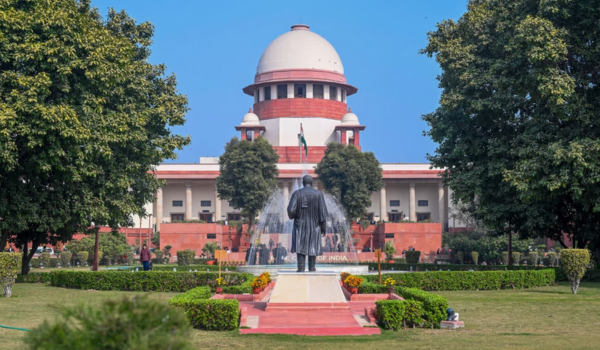
The Supreme Court is set to hear a petition filed by Congress leader Meenakshi Natarajan on Friday, challenging the rejection of her nomination for the Rajya Sabha from Madhya Pradesh.
Senior Advocate Abhishek Singhvi mentioned the matter before a bench comprising Justices P.K. Mishra and A.S. Chandurkar. The bench agreed to list the case for hearing on Friday, subject to the removal of any procedural defects.
Natarajan’s nomination was rejected by the Returning Officer during the scrutiny process on June 9.
Meanwhile, Returning Officer Arvind Sharma on Thursday declared BJP candidates Tarun Chugh, Rajneesh Agarwal, and Mahesh Kewat elected unopposed in the biennial Rajya Sabha elections from Madhya Pradesh. The newly elected members later collected their certificates from the Assembly complex in Bhopal and presented them to the media.
In her petition, Natarajan argued that the Returning Officer’s decision violated both the letter and spirit of the Representation of the People Act, 1951, and the rules framed under it. She contended that the rejection of her nomination undermined the principles of free and fair elections.
Seeking an urgent hearing, Singhvi informed the bench that June 11 was the final date for withdrawing nominations and argued that postponing the matter until Friday could adversely affect the case.
He referred to Section 33A of the Representation of the People Act, 1951, stating that candidates are required to disclose only those criminal cases in which the prescribed punishment exceeds two years and charges have already been framed by a court.
The objection to Natarajan’s nomination was raised by BJP Madhya Pradesh General Secretary Rahul Kothari, who alleged that she had not fully disclosed details of a case in the affidavit submitted along with her nomination papers. The objection pertained to a private complaint pending before a court in Hyderabad involving several individuals.
Referring to the Rajya Sabha election in Madhya Pradesh, Singhvi argued that Natarajan had not disclosed the Hyderabad case because only summons had been issued and the court had not even taken cognisance of the matter. He contended that the stage of framing charges arises only after cognisance, investigation, and the filing of a chargesheet, yet the Returning Officer had rejected her nomination through a brief order.
Emphasising the urgency of the matter, Singhvi noted that the deadline for withdrawal of nominations was that day and that, since the election was uncontested, the results could be declared after 4 p.m. He said he was prepared to argue the case the next day but urged the court to ensure that the results were not declared until the matter was heard.
Justice P.K. Mishra questioned the maintainability of the petition, observing that the election process was already underway. In response, Singhvi argued that courts could intervene in cases involving a clear and significant error; otherwise, the petitioner would be left without an effective remedy for years.
Appearing for the three BJP Rajya Sabha candidates from Madhya Pradesh, Senior Advocate Mukul Rohatgi opposed the mention of the matter, pointing out that his clients had not been made parties to the petition.
Senior Advocate D.S. Naidu, appearing for the Election Commission, also raised questions about the maintainability of the petition, arguing that the appropriate remedy was available through other legal avenues.
After hearing the submissions, the Supreme Court agreed to list Natarajan’s plea for hearing on Friday.
The controversy surrounding Natarajan’s nomination is linked to a criminal case registered in Telangana in 2022 on the basis of a complaint by a former associate of a senior Congress leader. The complainant alleged that she was subjected to abuse, coercion, intimidation, and exploitation during a personal relationship that lasted several months. The case is currently at the stage where the court is considering whether charges should be framed.
While Natarajan is not an accused in that criminal case, her name appears in a separate private complaint filed by the woman before a Hyderabad court in August 2025. Unlike the original criminal proceedings, the private complaint names not only the principal accused but also several Congress office-bearers, legislators, and party functionaries. The complainant has alleged that these individuals protected influential persons despite repeated complaints and ongoing legal proceedings.
The Congress has maintained that the matter cited against Natarajan does not constitute a criminal case.
In her petition, Natarajan argued that unless the Returning Officer’s order is stayed or set aside, it could create a troubling precedent for future elections across the country.
The plea further highlighted what it described as inconsistencies in the manner Returning Officers have interpreted and applied election laws in different states. It pointed out that while Natarajan’s nomination in Madhya Pradesh was rejected over what she termed minor and erroneous grounds, a Returning Officer in Jharkhand accepted another Rajya Sabha candidate’s nomination by relying on Section 36 of the Representation of the People Act, 1951, despite alleged omissions relating to assets and business interests. According to the plea, the Jharkhand Returning Officer held that scrutiny powers over Form 26 disclosures were limited.
Natarajan’s petition contended that such variations in the approach of Returning Officers require judicial intervention. It also alleged that the Election Commission had failed to act on complaints submitted by her and other party members regarding the issue.