
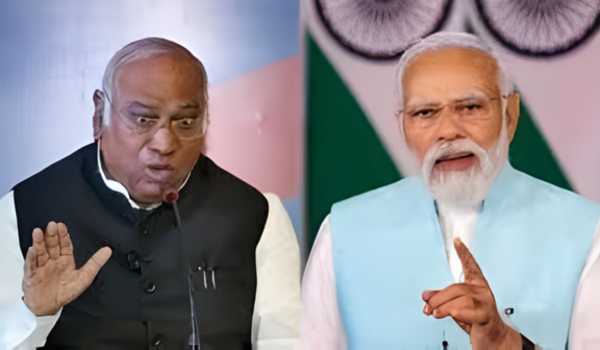
Congress leader Mallikarjun Kharge has issued a strong criticism of the Modi government, alleging that recent moves concerning the Mahatma Gandhi National Rural Employment Guarantee Act (MGNREGA) threaten the livelihoods of millions of rural Indians. According to Kharge, any reduction, delay, or potential scrapping of the programme would be a serious setback for poor and vulnerable communities across the country, many of whom depend on MGNREGA for steady employment and financial stability.
Kharge described the government’s actions as a “double blow” to the rural poor, arguing that it not only limits access to guaranteed work but also undermines the social safety net that has supported millions during times of economic uncertainty. He emphasised that MGNREGA is more than just a job creation scheme; it plays a critical role in ensuring food security, preventing migration due to lack of work, and supporting farmers and daily wage laborers during lean agricultural seasons.
The Congress leader pointed out that MGNREGA has historically been a lifeline for India’s most marginalized populations, including women workers, landless laborers, and marginalized communities in remote villages. By providing guaranteed wages for work on rural infrastructure projects, the scheme has helped reduce poverty, improve rural roads, water conservation, and other community assets, while also boosting household incomes.
Kharge urged the government to reconsider its approach, warning that any curtailment could lead to increased unemployment, heightened financial distress, and a widening gap between urban and rural economies. He also stressed that reducing the scheme would contradict the government’s stated goals of empowering rural communities and supporting inclusive growth.
Highlighting the broader socio-economic impact, Kharge noted that rural workers, who are heavily dependent on MGNREGA wages during periods of low agricultural activity, would face severe hardships if the scheme is compromised. “The government cannot ignore the voices of the millions who rely on this programme to sustain their families and communities,” he said, calling for urgent dialogue with stakeholders, including state governments, rural workers, and civil society groups.
The criticism comes amid rising concerns about rural unemployment, inflation, and the economic strain faced by households in India’s villages. Kharge’s comments add to a growing debate over the future of MGNREGA, a scheme that has been widely recognised as one of the most effective social welfare programmes in India, and its role in alleviating poverty and sustaining rural livelihoods
For more details and the fastest updates, follow us on @namma.updates. Stay informed and stay connected.