
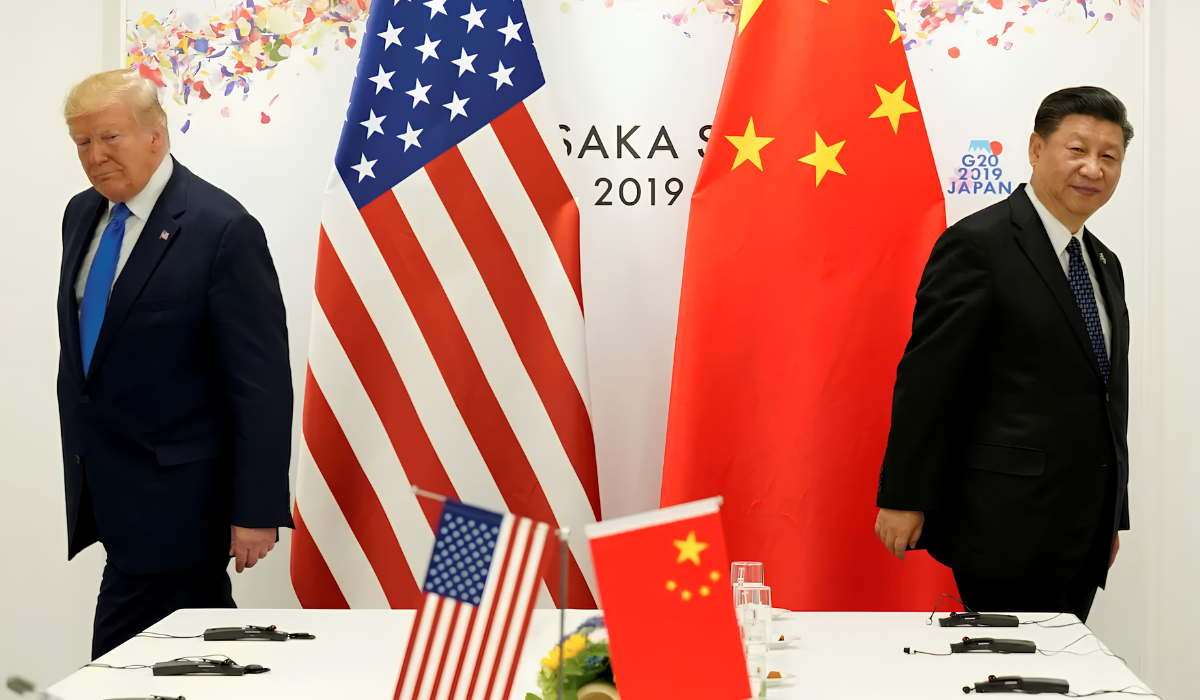
China considers democratically governed Taiwan part of its territory. As a result, US arms sales to Taipei are expected to be a key topic during this week’s two-day meeting between President Donald Trump and Chinese President Xi Jinping.
Ahead of US President Donald Trump’s two-day visit, Beijing reaffirmed its stance on major China-US issues, outlining “four red lines” that it says must not be crossed during this week’s superpower summit. According to the Chinese Embassy in the US, these “no-go” areas include China’s position on Taiwan and its right to development.
“The four red lines in China-US relations must not be crossed,” the embassy said in a post on X. The accompanying graphic identified Beijing’s non-negotiable issues as “The Taiwan Question”, “Democracy and Human Rights”, “Paths and Political Systems”, and “China’s Development Right.”
In another post on X, the embassy stressed that “China and the US should work towards building a strategic, constructive, and stable bilateral relationship.”
Reaffirming its wider diplomatic stance, the embassy further stated that “mutual respect, peaceful coexistence, and win-win cooperation remain the proper path for China and the US to engage with each other.”
Chinese President Xi Jinping first outlined the four red lines in a statement following his meeting with then-US President Joe Biden in November 2024.
China’s Position On Taiwan
China regards democratically governed Taiwan as part of its territory, making US arms sales to Taipei a key issue likely to be discussed during this week’s two-day meeting between US President Donald Trump and Chinese President Xi Jinping.
On Wednesday, China once again voiced strong opposition to US weapons sales to Taiwan and urged Washington to honor its commitments ahead of Trump’s visit to Beijing for the summit. Zhang Han, spokesperson for China’s Taiwan Affairs Office, stated that Taiwan is an internal matter and should be decided by the Chinese people.
“We firmly oppose the United States maintaining any form of military ties with Taiwan and strongly oppose US arms sales to the region. Our position on this matter has always been clear and consistent,” she said in Beijing.
Zhang further stated that Taiwan lies at the “core of China’s core interests” and said that honoring commitments made by successive US administrations is “an international responsibility that the US must fulfill.”
Under Washington’s “One China” policy, the United States officially does not take a stance on Taiwan’s sovereignty, although it acknowledges – without endorsing – Beijing’s claim over the island. At the same time, US law requires Washington to provide Taiwan with defensive support despite the absence of formal diplomatic relations.
In December, the Trump administration approved an $11 billion arms package for Taiwan, marking the largest such deal to date.
Beijing’s Other Concerns
China has also objected to what it describes as US interference in its internal affairs under the banner of democracy and human rights. Beijing continues to defend its socialist political system led by the Communist Party of China.
Issues such as China’s restrictions on rare-earth exports, the growing AI competition, and the often tense trade relationship between the two countries are also expected to feature prominently in discussions between the leaders of the world’s two largest economies.
At the same time, China has been stepping up efforts to counter Western sanctions by enforcing its 2021 blocking rules, which require domestic companies to disregard certain US penalties – particularly those linked to imports of Iranian crude oil.
Trump’s China Visit
US President Donald Trump is traveling to Beijing for talks with Chinese President Xi Jinping. The two-day visit – Trump’s first trip to China since 2017 – is set to feature high-level discussions alongside a packed schedule that includes a state banquet and a tea reception.
Trump arrives in China with more limited objectives after court rulings weakened his tariff agenda, shifting the focus towards securing trade agreements involving soybeans, beef, and Boeing aircraft.