
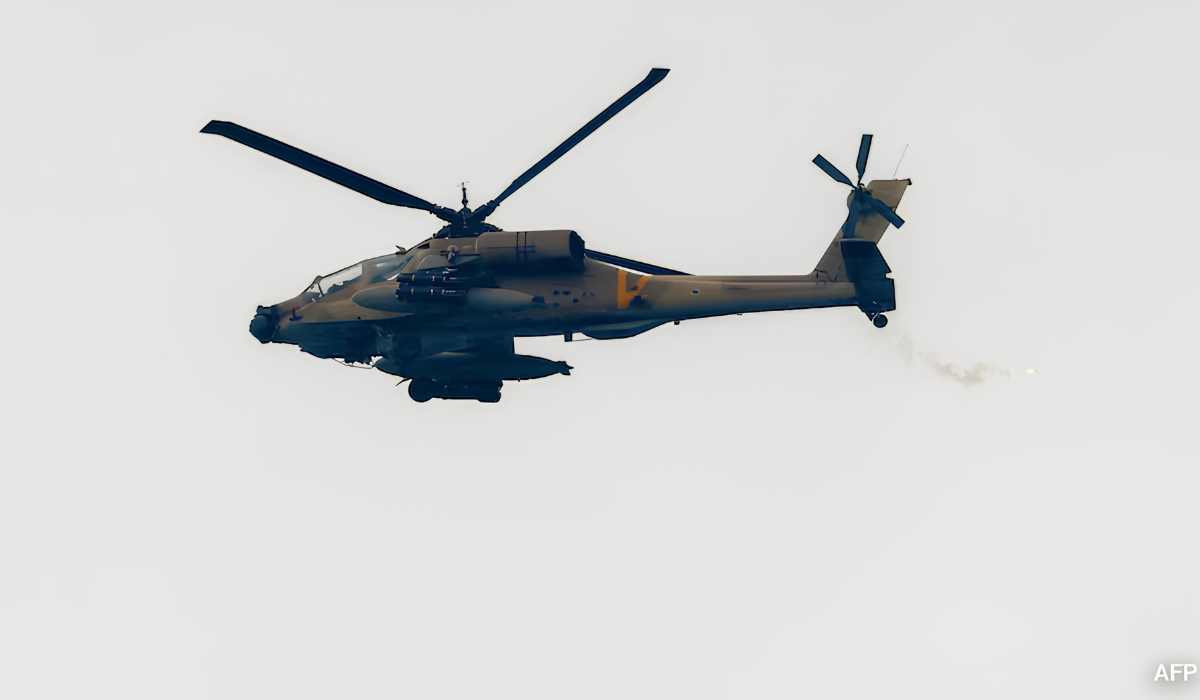
A United States Army Apache attack helicopter has reportedly crashed near the Strait of Hormuz. US President Donald Trump said both crew members were safely rescued and are “fine.”
The incident occurred a day after Iran and Israel exchanged fire, raising concerns over efforts to reinforce a fragile ceasefire in the ongoing Middle East conflict.
According to an initial report by The New York Times, the circumstances surrounding the crash remain unclear. It is not yet known whether the helicopter was brought down by Iranian fire, suffered a mechanical failure, or encountered another issue.
The US Department of State and US Central Command have not issued any official statements regarding the incident so far.
About Apache Helicopter
The US military has deployed Apache helicopters alongside MQ-9 Reaper drones and F/A-18 and F-35 fighter jets as part of Central Command’s efforts to counter Iran’s disruption of commercial shipping through the Strait of Hormuz.
Since hostilities began on February 28, Iran has reportedly downed at least 30 Reaper drones and several US fighter aircraft. If confirmed, the Apache crash would mark the first loss of its kind for the US military in the ongoing conflict.
Equipped with Hellfire missiles, the AH-64 Apache attack helicopter has played a significant role in US military operations aimed at enforcing restrictions on Iranian oil shipments and tankers, part of broader efforts to increase pressure on Tehran during ongoing negotiations. The helicopters have also been used by the United Arab Emirates to intercept and destroy Iranian drones during the conflict.
What Trump Said
Speaking to reporters at John F. Kennedy International Airport, President Donald Trump said his administration would release a report on the helicopter crash tomorrow.
Trump also voiced fresh optimism about ongoing negotiations with Iran, saying there is a “good chance” of reaching an agreement within the next “two or three days.” However, he did not elaborate on the reasons behind his confidence.
“We’re very close to a strong and meaningful deal,” Trump said, adding that while the US could continue military strikes, doing so would lead to significant destruction and loss of life while potentially disrupting shipping through the Strait of Hormuz for months.
He stressed that he would prefer a diplomatic resolution, noting that further military action could result in heavy casualties.
Meanwhile, mediators, led largely by Pakistan, have been working for weeks to bridge the gap between Washington and Tehran. Despite these efforts, both sides remain firm on key issues.
The US is seeking the surrender of Iran’s stockpile of highly enriched uranium, believed to remain in the country following American airstrikes during the 12-day conflict in 2025. Iran has rejected that demand, instead calling for sanctions relief and the release of frozen assets before any final agreement is reached – conditions that the Trump administration has so far refused to accept.