
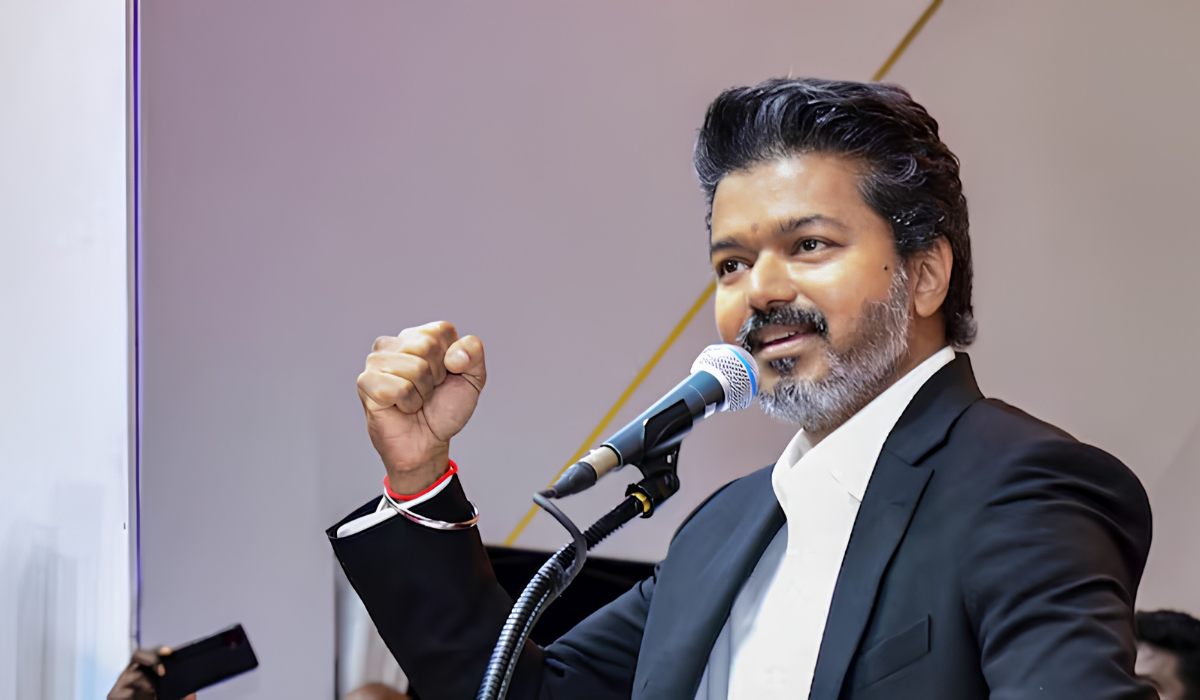
In Tamil cinema, a hero’s introduction is often grand, dramatic, and unforgettable. When C. Joseph Vijay took oath as Tamil Nadu’s ninth Chief Minister on May 10, reality seemed to mirror that cinematic tradition. The actor-turned-politician ended the decades-long dominance of the state’s two major Dravidian parties, securing a mandate few would have predicted.
A month into his tenure, however, the spotlight has shifted from the excitement of his arrival to the realities of governance. While his administration has shown ambition and intent, it has also encountered a number of notable challenges and early setbacks.
Leadership from the Top
One of the most talked-about aspects of Vijay’s first month in office has been his work style rather than his policies. The Chief Minister has gained attention for arriving at the Secretariat punctually every day, with his trademark black suit and white shirt marking a clear departure from the traditional white veshti long associated with Tamil Nadu politics.
Vijay reportedly spends around seven hours at his office from Monday to Friday, expects the same level of punctuality and discipline from government officials, and often brings his own lunch, eating quietly in his cabin. While such gestures may appear largely symbolic, they have helped shape an image of a leader focused on discipline, professionalism, and setting an example from the top.
Liquor Policy and Women’s Safety
One of the government’s most significant early moves was the closure of 717 state-run TASMAC outlets situated within 500 meters of places of worship, educational institutions, and bus stands. The shutdown included 276 outlets near religious sites, 186 near schools and colleges, and 255 near bus terminals. By completing the exercise within two weeks, the administration delivered on a key election promise made in the TVK manifesto.
The closure of these outlets directly impacted 3,474 employees, although the government quickly reassigned most of them to other TASMAC stores. Critics argue that with more than 4,700 TASMAC outlets still operating across Tamil Nadu, the move addresses the location of liquor shops rather than the larger issue of alcohol availability. Balancing public sentiment with the significant revenue generated by TASMAC is likely to remain a key challenge for Vijay’s administration.
On women’s safety, the government has moved beyond promises to implementation. The Singapenne (Lioness) Special Task Force, officially launched on June 9, has been established as a dedicated police unit to tackle crimes against women and children. Led by senior IPS officer K. Bhavaneeswari, the force is being deployed across all districts in the state. Its effectiveness, however, will ultimately be measured by its impact on the ground rather than the ambition of its mandate.
Cracking Down on the Contractor Nexus
One of the new administration’s boldest political initiatives has been its commitment to eliminating kickbacks in public infrastructure projects. Clear instructions were issued to the Public Works and Highways departments, warning both contractors and government officials against engaging in commission-based practices.
Contractors’ Association President Gunamani publicly stated that the government had directed contractors not to pay bribes to ministers or officials. He also alleged that under the previous administration, contractors were routinely required to pay commissions of up to 15 per cent to secure project approvals.
Whether this policy leads to meaningful, long-term reform or remains merely a declaration of intent will depend on how consistently and effectively it is implemented.
From Vision to Action
The Vijay government has based its initial governance agenda on the Vetri Tamizhagam Vision Document, a comprehensive 436-point roadmap covering 35 state departments. Designed to promote accountability and track progress across sectors, the blueprint lays out an ambitious agenda, though its extensive scope also raises questions about the practicality of delivering on every commitment.
The document is backed by a strong anti-corruption stance. The Chief Minister has made it clear that officials found engaging in corrupt practices will face strict action, irrespective of their political connections. In his inaugural address, Vijay also vowed to dismantle informal power networks and middlemen who have traditionally profited from government processes, promising instead a streamlined single-window clearance system aimed at improving transparency and efficiency.
A Fresh Push for Amma Unavagam
Within two weeks of taking office, Vijay initiated a major overhaul of the 620 Amma Unavagam canteens functioning across Tamil Nadu, including 383 managed by the Greater Chennai Corporation and 237 operated by other municipalities and town panchayats. After reviewing the facilities, the Chief Minister instructed local bodies to replace worn-out equipment, modernize kitchens, improve hygiene standards, and put in place efficient systems for handling public grievances. The renovation and procurement of new supplies are to be financed through the general funds of the respective municipal corporations.
The Amma Unavagam network, a vital source of low-cost meals for daily-wage earners, urban poor communities, and economically disadvantaged families, had deteriorated noticeably in several areas over the years. The government’s intervention reflects an effort to restore the canteens to a better standard of operation and improve the quality of service they provide.
Early Challenges
The administration’s first month has also seen its share of controversies. One of the earliest involved the appointment of an astrologer as Officer on Special Duty, a decision that triggered sharp criticism from opposition parties as well as allies within the ruling coalition, including Congress, the VCK, and Left parties. Facing mounting backlash, the government withdrew the appointment within 24 hours. While some viewed the swift reversal as a sign of responsiveness, others saw it as evidence of inadequate scrutiny before the decision was made.
Another controversy emerged over a water tank tender in Kancheepuram, where a six-hour submission window prompted allegations that the process had been structured to benefit a specific contractor. The government subsequently cancelled the tender, resulting in a second policy reversal within its first week in office.
Opposition parties, led by Udhayanidhi Stalin’s DMK, have maintained that the government’s early controversies cannot simply be attributed to administrative inexperience, arguing instead that they reflect deeper shortcomings in decision-making.
Another point of criticism has been Vijay’s first major public appearance as Chief Minister at a thanksgiving rally in Trichy on June 1. Critics noted that the speech focused heavily on political attacks against the DMK and AIADMK rather than outlining governance priorities or new policy initiatives. Supporters, however, viewed the event as proof of his continued popularity and ability to connect with large audiences. For detractors, it raised concerns about whether the Chief Minister is devoting enough attention to the day-to-day responsibilities of governing the state.