
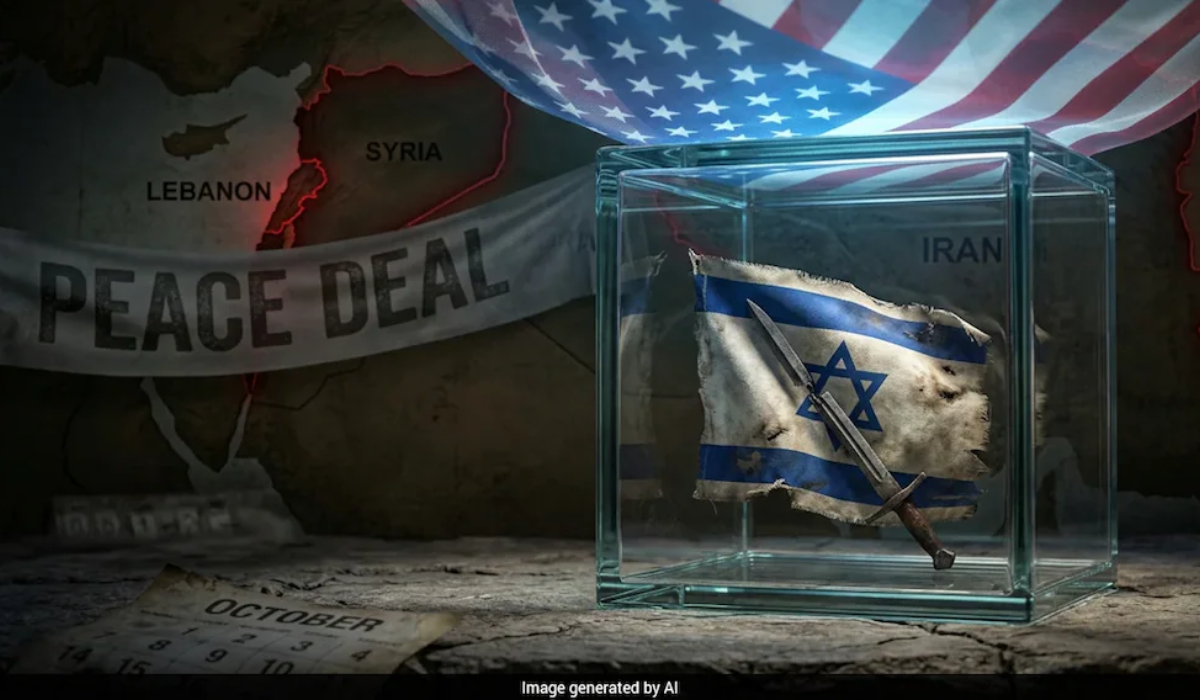
Donald Trump’s peace initiative involving Iran and Lebanon has narrowed Benjamin Netanyahu’s room for maneuver. As elections draw closer, here’s what Israel can do next and what it could mean politically at home.
Benjamin Netanyahu is running out of time – both politically and personally.
The 76-year-old is seeking a seventh term in office in elections expected by October. However, with many Israelis still angered by the October 7 Hamas attack, along with the corruption and fraud cases hanging over him, his path to re-election is far from certain.
Netanyahu had hoped to strengthen his image as a hardline leader by highlighting Israel’s confrontations with Iran and its Lebanese proxy, Hezbollah, portraying both as existential threats to the country. But that strategy appears to have lost momentum following the proposed US-Iran peace deal, which has reshaped the regional landscape and narrowed the political advantage he had hoped to gain.
War-Based Political Strategy Falls Apart
Benjamin Netanyahu now finds himself with fewer strategic options. The path ahead appears to be driven more by political maneuvering than military escalation, although it could still involve carefully calibrated action against Hezbollah.
His central political message – that he is the leader best equipped to protect Israel from Hezbollah in the north while resisting international pressure for Palestinian statehood – remains intact. However, that narrative has been weakened by the October 7 Hamas attack and the two ongoing conflicts, both of which remain unresolved.
Netanyahu is likely to continue highlighting Israel’s military campaign in Gaza as a key part of his security credentials. However, the proposed US-Iran peace deal, along with its provisions relating to Lebanon, has significantly reduced his room to escalate military operations as a way to project strength and appeal to voters – particularly those within his far-right support base who favor a more decisive military outcome.
Trump’s Peace Deal Complicates Israel’s Northern Strategy
Trump’s peace deal has complicated Netanyahu’s electoral calculations, particularly in northern Israel. A June survey by Israel’s Hebrew University found support for Netanyahu’s Likud party had fallen significantly, with concerns over a potential peace agreement – one that could limit Israel’s military action against Hezbollah – contributing to the decline. The poll showed only 23 per cent backing Likud, down from 35 per cent in 2022.
As a result, Netanyahu now appears to have fewer options. His campaign is likely to rely on a blend of political messaging and carefully calibrated military posturing in an effort to reassure voters and rebuild support ahead of the elections.
Limited Military Action, Not Escalation
One option available to Netanyahu is to pursue limited military action – enough to demonstrate resolve on Israel’s northern front and reassure domestic critics, but not so extensive that it risks clashing with President Donald Trump’s diplomatic agenda. With Republicans heading into the November midterm elections for the House and Senate, Trump appears increasingly focused on containing the conflict, if not bringing it to an end, rather than allowing it to widen.
The US president has already publicly expressed criticism of Netanyahu’s military approach in Lebanon, underscoring Washington’s preference for restraint over further escalation.
The reported tensions between Trump and Netanyahu were also reflected in a private phone conversation, during which Trump is said to have sharply criticized the Israeli leader. According to reports, he told Netanyahu: “You’d be in prison if it weren’t for me. I’m saving your ass. Everybody hates you… hates Israel because of this.” Meanwhile, US Vice President JD Vance struck a similarly cautionary tone, saying, “Trump is the only head of state in the world who is sympathetic to Israel at this moment…”
Despite the reported exchange, both leaders later sought to downplay any rift. In an interview with CNBC, Netanyahu maintained that US-Israel ties remained strong despite occasional differences. Trump echoed that sentiment in comments to the New York Post, while acknowledging his frustration over Israel’s operations in Lebanon. “I was a little bit perturbed at his constantly fighting with Lebanon. At some point I said, ‘Bibi, we’ve got to stop this. We gotta stop it,'”
he said.
Just days after the agreement was signed, Israeli forces launched strikes in southern Lebanon, killing at least 16 people. The attack heightened concerns that continued hostilities could undermine the deal’s call for a halt to military operations “on all fronts, including in Lebanon.”
US Vice President JD Vance had been expected to travel to Switzerland to oversee the final round of negotiations, but the visit was later cancelled. While the White House attributed the decision to logistical issues, a report by the pan-Arab satellite channel Al-Mayadeen, which is politically aligned with Hezbollah, claimed Iran had delayed sending its delegation because of Israel’s ongoing military operations in Lebanon.
After Declaring Victory, Attention Turns to Hezbollah
Meanwhile, Netanyahu has declared what he describes as a “victory” over Iran.
Speaking last week, he said the joint US-Israel strikes had spared Israel from the threat of “nuclear annihilation.” Although the full details of Washington’s agreement with Tehran have yet to be made public, the deal is widely believed to require Iran to abandon any pursuit of nuclear weapons and surrender its stockpile of enriched uranium.
With the Iran issue seemingly moving toward diplomacy, Netanyahu has shifted his attention back to Hezbollah.
This week, he said Israeli forces would continue to occupy roughly 570 square kilometers of southern Lebanese territory despite the US-Iran agreement. “We will stay in the Lebanon security buffer zone for as long as necessary,” he told reporters.
Tehran, however, has maintained that any agreement must also secure peace in Lebanon.
For its part, Hezbollah told Reuters it would be open to maintaining peace provided Israel refrains from launching attacks. Israeli military officials also told the Jerusalem Post that if Hezbollah did not initiate hostilities, Israel would likewise avoid military action.
The prospect of a fragile peace now appears more realistic than it has in months, a goal Trump has increasingly championed as he seeks to prevent a broader regional conflict, while also responding to growing domestic political pressure and the mounting financial and military costs of continued US involvement.
Caught in the US Alliance
Netanyahu, however, is also aware that Israel’s strategic partnership with the United States leaves him with limited room to manoeuvre. With Israel having received approximately $3.8 billion in annual US military assistance since 2019, he cannot afford to push back too strongly against Washington’s position or risk straining a relationship that remains vital to the country’s security.
Netanyahu is also aware that many within Israel’s hardline political camp view any end to the conflict – without the complete dismantling of Iran’s regime – as an opportunity for both Tehran and Hezbollah to regroup and rearm, particularly if the US agreement results in the easing of economic sanctions.
Maintaining Israeli troops in southern Lebanon offers him a political middle ground. While such an arrangement may not fully satisfy either Washington or Tehran, it is likely to be tolerated by both sides and helps Netanyahu preserve his image as Israel’s security guarantor.
It also gives him scope to continue limited operations against Hezbollah, reassuring voters in northern Israel without triggering a broader conflict. Any such actions, however, are likely to remain carefully calibrated and within the boundaries considered acceptable by both the Trump administration and Iran.
Netanyahu’s Central Challenge
Netanyahu’s central challenge now is how to maintain a credible image of deterrence without triggering a full-scale war—one that would require strong US backing and long-term diplomatic support.
Peace Creates New Challenges
Peace with Iran – and by extension, a reduction in tensions with Hezbollah – could work to Netanyahu’s advantage.
It lowers the immediate risk of an open-ended conflict, particularly one involving simultaneous fronts that could rapidly escalate into a wider regional war. A more stable security environment would also allow his government to shift greater attention to Israel’s economy, which has been strained by prolonged military operations.
At the same time, peace presents a political challenge. Netanyahu has long cultivated an image as a strong leader during times of national security crises. With the immediate threat receding, he may have to rely less on the politics of conflict and more on political messaging, governance, and coalition-building to persuade voters.
In that sense, his challenge has shifted from leading Israel through wartime to navigating the constraints and complexities of peacetime politics.