
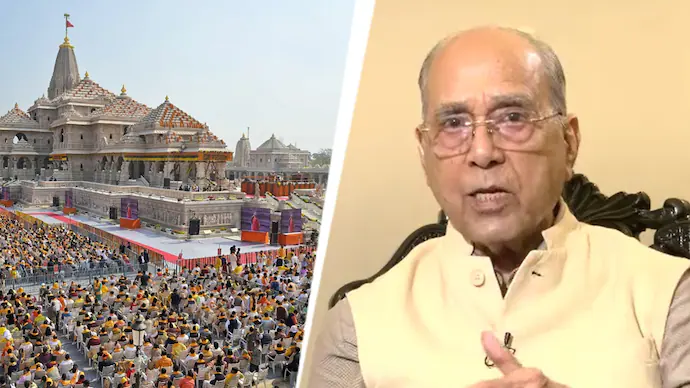
Amid the controversy surrounding the alleged misappropriation of donations at the Ram Temple in Ayodhya, Ram Janmabhoomi Temple Construction Committee Chairman Nripendra Misra has called for a complete overhaul of the shrine’s management system, saying the episode has exposed serious shortcomings in oversight, accountability, and adherence to established procedures.
In an exclusive interview with India Today TV, Misra said the alleged irregularities had not only shaken the trust of devotees but also highlighted significant weaknesses in the temple’s administrative and governance framework.
“I have not formally submitted any proposal, but I have expressed my views publicly. In my opinion, the entire management system needs to be restructured and placed in the hands of experienced professionals,” said Nripendra Misra, a retired IAS officer and former Principal Secretary to Prime Minister Narendra Modi.
The controversy began after allegations emerged of discrepancies in the accounting of donations made to the Ram Temple, with estimates ranging from about Rs 7 crore to significantly higher, unverified figures. The claims sparked a political row and were followed by the recovery of cash from the residence of a temple employee.
In response, the Uttar Pradesh government set up a three-member Special Investigation Team (SIT) to examine donation registers, vault records, and CCTV footage. Meanwhile, the Shri Ram Janmabhoomi Teerth Kshetra Trust has denied any wrongdoing, stating that its accounts are audited regularly and that no financial irregularities have been found.
The former bureaucrat said the controversy had caused him deep anguish, particularly because it surfaced when the Ram Temple project is nearing completion.
“I am deeply hurt, especially because this has happened at a time when I am almost concluding my responsibility for the temple’s construction,” he told India Today TV.
Describing the temple’s current administrative setup, Nripendra Misra said much of its day-to-day functioning relies on an informal, volunteer-based system rather than a well-defined institutional framework.
“At present, the management functions in a different manner. Most of the people working there are volunteers. They are informally told how to perform their duties, but there are no written orders, no fixed responsibilities, and no proper distribution of work,” he said.
Misra noted that nearly 1,500 people are involved in various activities across the temple complex, making it imperative to establish a structured and accountable management system.
He argued that an institution of this scale – one that attracts millions of devotees and receives substantial donations from across India and abroad – requires clearly defined administrative procedures, transparent governance, and robust accountability mechanisms.
‘This Has Hurt the Trust of Devotees’
Referring to the controversy over the alleged theft of temple donations, Nripendra Misra said the incident had raised serious concerns about the mechanisms put in place to protect and account for devotees’ contributions.
“This incident has undoubtedly shaken the faith of devotees and caused them distress. At the same time, it raises serious questions about the effectiveness of the temple’s management and oversight mechanisms,” Nripendra Misra said.
Misra said he had reviewed documents and directives issued between 2023 and 2025 relating to the handling and counting of temple donations and found that comprehensive Standard Operating Procedures (SOPs) had already been laid down.
“I have examined documents containing instructions issued between 2023 and 2025. There was a detailed SOP in place. Had it been implemented properly, we would not be facing this situation today,” he said.
Emphasising the thoroughness of the guidelines, Misra noted that the SOP even prescribed the attire to be worn by personnel responsible for counting donations.
“It specified details such as the clothing to be worn by anyone entering the counting room, with those garments to be provided by the State Bank of India. Every entry and exit was also supposed to be monitored and verified. However, based on what I have learned informally, these procedures were not followed,” he said.
Major Gaps Found in Cash and Valuables Management
Misra also highlighted shortcomings in the procedures for handling various types of donations, including cash, coins and precious metals, saying stronger safeguards and oversight were needed to ensure transparency and accountability.
Explaining the donation process, Nripendra Misra said devotees often place cash, jewellery and other valuables into donation boxes out of deep faith, making strict oversight essential at every stage of handling.
“When a woman stands before the deity and offers her jewellery, she removes her ring or ornament and places it in the donation box out of pure devotion. When those boxes are opened for counting, currency notes, coins and precious metals are all mixed together,” he said.
“I believe there were serious shortcomings in the accounting and handling of all three categories,” he added.
Misra said the deficiencies went beyond the counting process and reflected broader weaknesses in supervision and accountability.
The former Principal Secretary to Prime Minister Narendra Modi said the oversight mechanism involving bank officials and representatives of the temple trust lacked the level of rigour required for managing such large volumes of donations.
“More importantly, the supervision itself was weak. Two representatives from the bank and two from the trust were supposed to oversee the process, but the monitoring remained largely informal,” he said.
He also pointed to gaps in oversight even after the donations had been counted and transported to the bank.
“When cash, jewellery and other valuables were taken to the bank, the level of control that should have existed was missing. Somewhere, there was a clear lack of monitoring and oversight,” he said.
Misra said that integrity and effective supervision are the cornerstones of any sound management system, adding that the alleged lapses point to shortcomings in both areas.
Political Tensions Escalate in UP Over Ayodhya Controversy
The controversy began after allegations by former Ayodhya MLA Pawan Pandey, who claimed that at least Rs 7 crore in temple donations had been misappropriated. The allegations quickly gained political traction, with opposition leaders, including Akhilesh Yadav, citing reports that suggested crores of rupees donated to the Ram Temple could not be accounted for. Describing the matter as highly sensitive because of the deep religious faith associated with the shrine, Yadav urged the judiciary to take cognisance of the allegations and sought greater transparency over the management of devotees’ contributions.
As the controversy escalated, it extended beyond opposition criticism. Former BJP MP Brij Bhushan Sharan Singh further intensified the debate by claiming he was aware of the alleged misuse of donations, though he stopped short of revealing specific details publicly.
The issue also drew attention from within the BJP. Senior party leader Rajneesh Singh wrote to Prime Minister Narendra Modi seeking greater transparency in the temple trust’s financial affairs. He called for the public disclosure of donations, expenditures, assets, bank accounts, and land transactions, arguing that devotees who had contributed to the temple were entitled to know how their offerings were being managed and utilized.
The trust, however, has firmly denied any allegations of financial wrongdoing. Shri Ram Janmabhoomi Teerth Kshetra Trust General Secretary Champat Rai said internal audits were being conducted regularly and that no evidence of missing funds or financial irregularities had been found. He added that representatives of both the trust and the State Bank of India routinely participated in the audit process, with no suspicious findings reported.
The Shri Ram Janmabhoomi Teerth Kshetra Trust also approached the Uttar Pradesh government, seeking a thorough and impartial investigation into the allegations. It contended that rumours and misinformation were being circulated on social media in an attempt to tarnish the temple’s image and hurt the sentiments of millions of devotees.
Responding to the request, the Uttar Pradesh government constituted a three-member Special Investigation Team (SIT) on June 13. The panel comprises Lucknow Divisional Commissioner Vijay Vishwas Pant, Inspector General of Police Kiran S, and Finance Department Special Secretary Neel Ratan.
As the controversy intensified, Uttar Pradesh Chief Minister Yogi Adityanath urged restraint while the investigation is underway. Expressing confidence in the SIT, he said the probe would establish the “absolute truth” and appealed to people to refrain from making unsubstantiated claims that could hurt the sentiments of devotees. He also encouraged anyone with credible evidence related to the allegations to submit it to the SIT, asserting that no one found guilty would be spared, regardless of their position or status.