
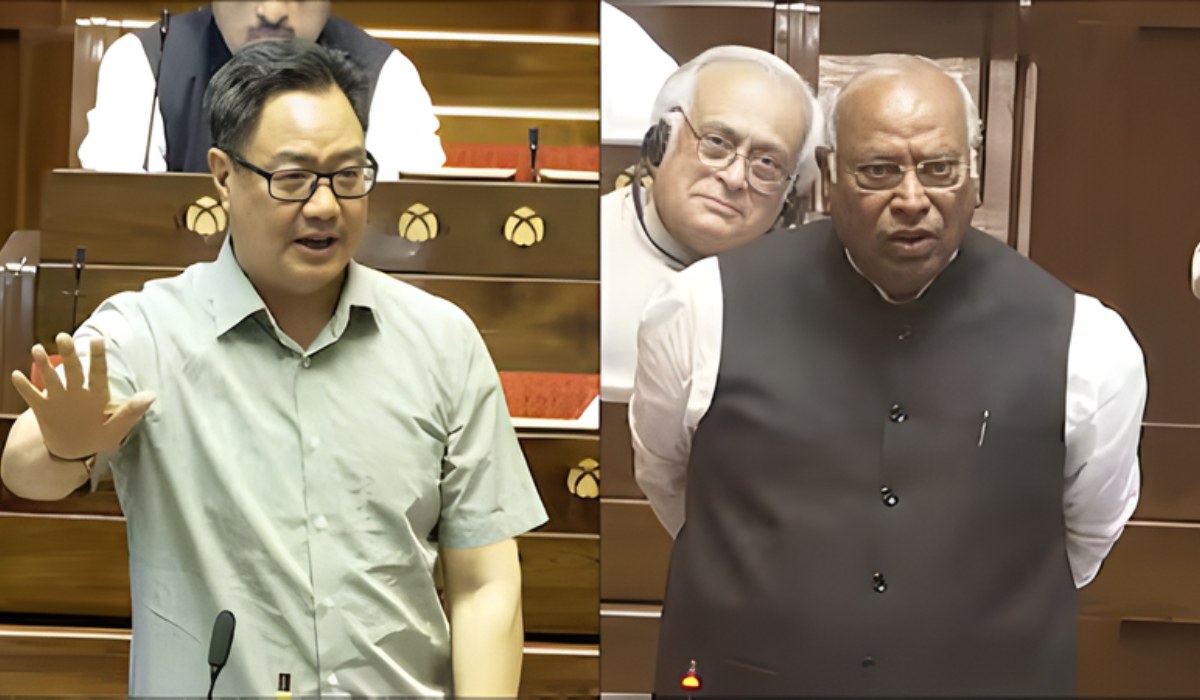
A sharp exchange broke out in the Rajya Sabha on Wednesday between Kiren Rijiju and Mallikarjun Kharge as the opposition demanded a debate on the West Asia conflict that was driving up oil and LPG prices.
Speaking in the House, Mallikarjun Kharge accused the BJP of pushing through legislation at will while avoiding a discussion on the Iran war despite repeated notices. He said rising prices were being ignored and questioned whether such actions reflected a true democracy.
Responding to Mallikarjun Kharge’s allegations, Kiren Rijiju pointed to Prime Minister Narendra Modi’s detailed statement on the war in both Houses, adding that an all-party meeting was convened on the West Asia conflict, but the leaders of the opposition were absent, while other parties were present.
‘Where Was Your PM?’
Kiren Rijiju said Finance Minister Nirmala Sitharaman had informed the House about the government’s measures to control fuel prices amid the conflict, adding that the Prime Minister reduced excise duties to shield citizens from rising costs and urged against politicising the issue, calling for unity.
Mallikarjun Kharge countered that Prime Minister Narendra Modi was himself absent from the all-party meeting, saying that just as the Prime Minister sent a representative, the Opposition had also deputed its representatives.
Mallikarjun Kharge said that like the government, the Opposition had sent a representative, questioned the authority of the remarks in the Prime Minister’s absence, and strongly condemned the statements.
Kiren Rijiju accused Mallikarjun Kharge of refusing to listen to the government despite being given due respect and of shirking his responsibilities, adding that his remarks in the House were aimed at criticising the Prime Minister.
This comes amid ongoing disruptions in markets due to the West Asia conflict, which has driven up fuel and LPG prices. Commercial LPG rates were increased by ₹195.50 on Wednesday, raising costs for businesses such as hotels, restaurants and small enterprises.
Addressing the Lok Sabha last month, Prime Minister Narendra Modi described the situation as “worrisome,” saying the ongoing conflict has posed economic, national security and humanitarian challenges for India, given the region’s importance for energy supplies, trade routes and its large Indian diaspora.
According to him, India has wide-ranging trade relations with countries caught in the conflict, and the region plays a critical role as a trade route, particularly for its crude oil and gas needs.