
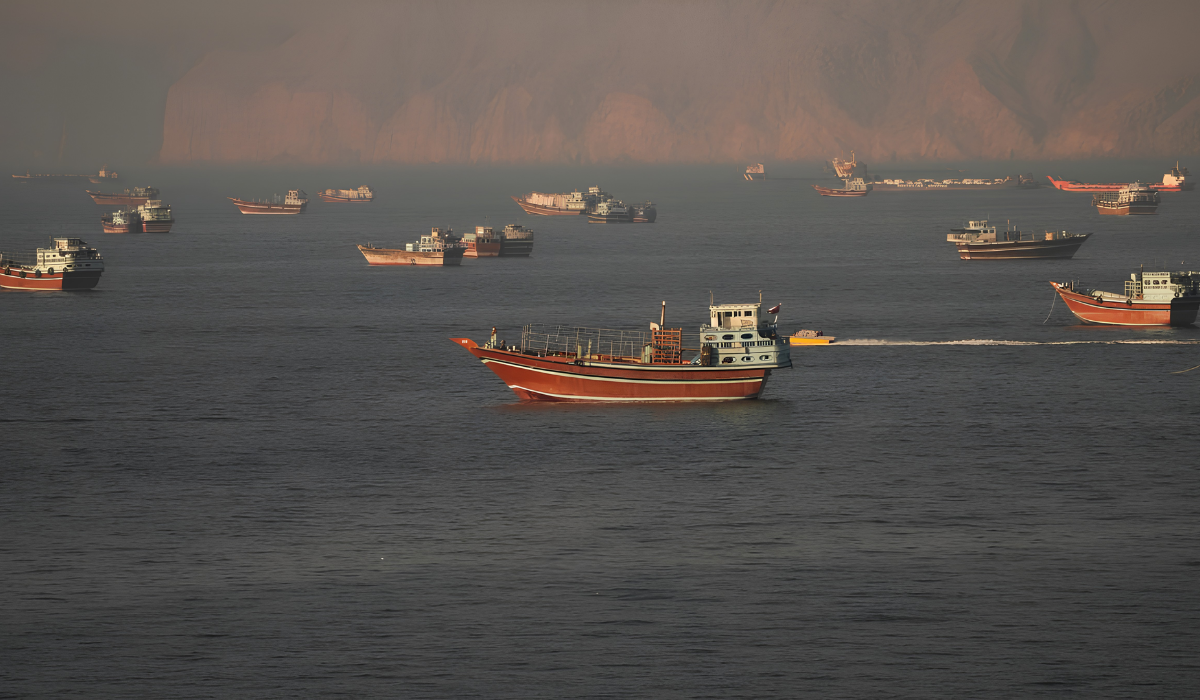
The United States said on Monday (June 15, 2026) that commercial vessels would be allowed to transit the Strait of Hormuz without paying tolls under a peace agreement with Iran signed by President Donald Trump. Washington also stressed that Tehran must first meet its obligations under the deal before receiving any economic benefits or sanctions relief.
The package includes a proposed $300 billion reconstruction fund for the conflict-hit country. However, a senior Trump administration official said the money would be released only if the country meets its commitments under the agreement.
U.S. officials said President Donald Trump, Vice President J.D. Vance, and Iranian Parliament Speaker Mohammad Bagher Ghalibaf signed the memorandum of understanding (MoU) electronically on Sunday (June 14, 2026).
“The President chose to sign the agreement personally to underscore his commitment to the peace process,” a U.S. official, speaking on condition of anonymity, said. However, Vice President J.D. Vance acknowledged that the preliminary memorandum leaves the most contentious issues unresolved, particularly Iran’s nuclear program, deferring them to future negotiations.
“The MoU runs to about a page and a half and is a highly general document,” Mr. Vance said in an interview with CNN.
Mr. Vance later told NBC that U.S. and international nuclear inspectors would be permitted to return to Iran to oversee the dismantling of the country’s stockpile of enriched uranium. He is also expected to lead technical negotiations this week before attending the formal signing ceremony in Geneva, Switzerland.
Speaking at the G7 summit in France, Mr. Trump said the text of the agreement would likely be made public after Friday (June 15, 2026). However, U.S. officials indicated that it is expected to be released within the next 24 to 48 hours.
Hormuz to Return to Normal in ‘Couple of Weeks’?
The signing will begin a 60-day negotiation period during which Tehran and Washington will work toward finalizing a comprehensive peace agreement. “Our priority is to address the nuclear issue first,” a U.S. official said during the call.
Reopening the Strait of Hormuz remains an immediate priority because of the global economic impact of surging oil prices.
Speaking to CNBC, Mr. Vance said there was an understanding with Iran that the strategic waterway would remain open to international shipping without tolls over the long term, with the details to be finalized during upcoming technical negotiations.
Mr. Trump, meanwhile, said the vital shipping route would be “completely open” by Friday (June 19, 2026), while noting that demining operations were still underway to ensure the waterway was safe for navigation.
The first U.S. official said shipping traffic is expected to recover to pre-war levels within the next couple of weeks, adding that maritime activity has already increased substantially.
However, Iran’s Foreign Ministry said on Monday (June 15, 2026) that the agreement would permit Tehran to levy maritime service charges on vessels transiting the Strait of Hormuz, stressing that these would be service fees rather than transit tolls.